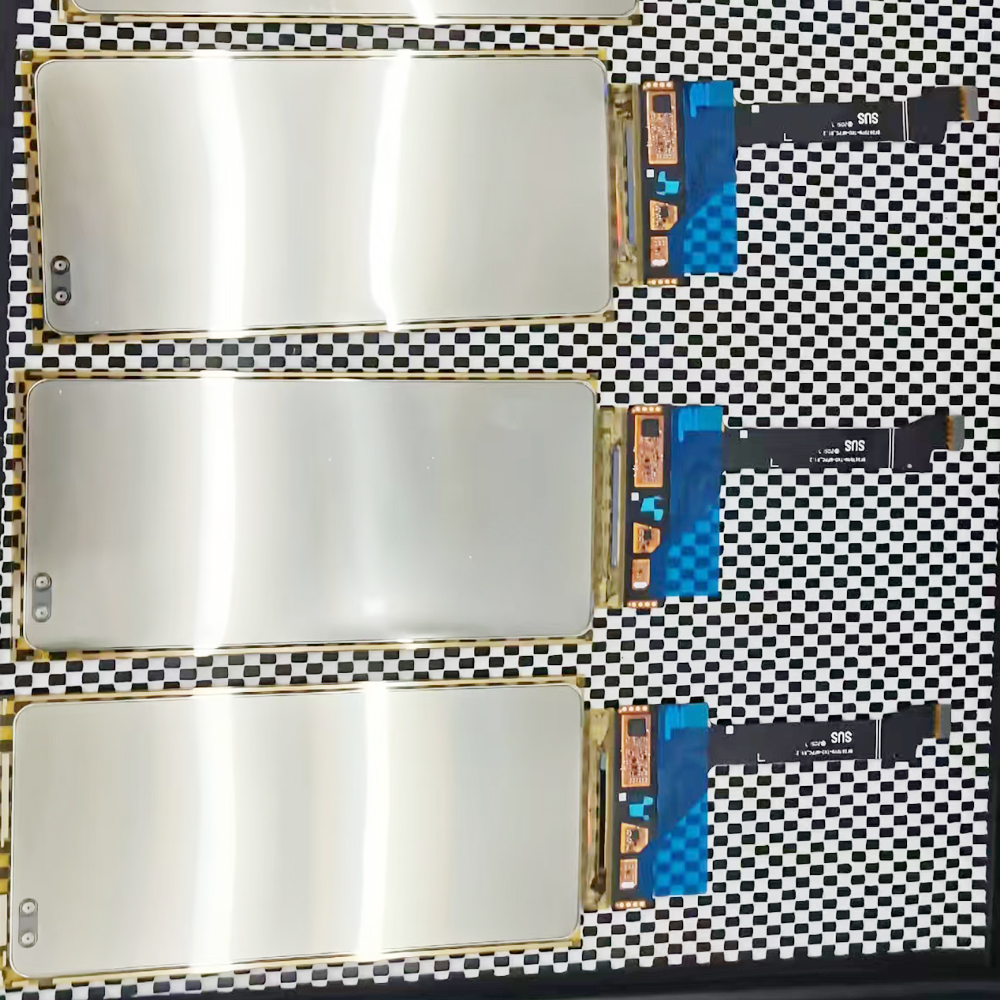
Flexible AMOLED Manufacturing: Full Process & Detailed Module Assembly
Clarification on AMOLED Technology
Before detailing the manufacturing workflow, it is crucial to clarify a fundamental technical distinction: AMOLED (Active-Matrix Organic Light-Emitting Diode) is a self-emissive display technology. Unlike LCDs, AMOLED screens do not require a backlight unit (BLU). Therefore, there is no “backlight assembly” step in this process. The complete production workflow is divided into four primary stages: Array, OLED Evaporation, Encapsulation, and Module Assembly.
1. Array Stage (TFT Backplane Fabrication)
This stage focuses on fabricating the driving circuits on a flexible substrate to provide precise electrical signals to each pixel.
Substrate Preparation: A Polyimide (PI) slurry is coated onto a temporary carrier glass and cured at high temperatures to form the flexible base.
Thin Film Deposition & Photolithography: Through 7 to 10 repetitive cycles of PECVD/PVD deposition, photolithography, and etching, the Low-Temperature Polysilicon (LTPS) TFT array circuits are constructed.
Pixel Definition Layer (PDL): Photosensitive PI is coated and patterned to precisely separate RGB sub-pixels and prevent color crosstalk.
Automated Optical Inspection (AOI): Advanced CDC equipment screens for circuit shorts, opens, and film defects.
2. OLED Stage (Vacuum Evaporation)
This is the core stage where organic light-emitting materials are precisely deposited into pixels under high vacuum.
Substrate Cleaning: Ultrasonic, chemical, and plasma treatments remove microscopic contaminants.
Vacuum Evaporation: At an ultra-high vacuum (10⁻⁶ to 10⁻⁷ Pa), a Fine Metal Mask (FMM) is used to sequentially evaporate the Hole Injection Layer (HIL), Hole Transport Layer (HTL), RGB Emitting Layers, Electron Transport Layer (ETL), and a semi-transparent cathode.
Light-Off Test (LOT): An initial power-on test is conducted immediately after evaporation to rapidly detect bright spots, dark spots, or bright lines.
3. Encapsulation Stage
Since organic materials are highly sensitive to moisture and oxygen, this stage provides a protective shield.
Thin Film Encapsulation (TFE): Alternating layers of inorganic materials (e.g., SiNx/Al₂O₃) and organic planarization layers (typically 3-6 layers) are deposited to achieve superior barrier properties.
Laser Lift-Off (LLO): An exclusive step for flexible screens. An excimer laser irradiates the back of the carrier glass, seamlessly separating the PI flexible substrate from the glass without damage.
Laser Cutting: The large panel is cut into individual cells using precision lasers, followed by edge grinding to prevent chipping.
4. Module Assembly Stage (In-Depth Breakdown)
This stage integrates the bare panel into a fully functional display module. It is the most complex phase involving precision mechanical and chemical processes.
A. Polarizer Attachment A Circular Polarizer (CPL) is laminated onto the panel to absorb ambient light reflections, significantly enhancing contrast and outdoor visibility.
This step establishes the electrical connection between the display panel and external control systems.
ACF Attachment: Anisotropic Conductive Film (ACF) is pre-bonded to the panel’s bonding pads. ACF contains conductive particles that ensure vertical electrical conductivity while providing horizontal insulation.
COF/COP Binding: The driver IC is aligned and thermally compressed onto the flexible film (or directly onto the panel). Critical parameters include temperature (typically 180°C-220°C), pressure, and dwell time to ensure optimal particle deformation and bonding strength.
FPC Bonding: The Flexible Printed Circuit (FPC) is similarly aligned and hot-pressed to transmit signals.
AOI & Electrical Testing: Automated equipment checks for alignment shifts, ACF overflow, and conducts continuity/resistance tests to verify electrical pathways.
C. Dispensing & Sealing Process To protect vulnerable bonding areas and enhance structural integrity:
Edge Dispensing: UV-curable adhesives or epoxy resins are precisely dispensed along the edges of the cover glass or bonding regions using high-precision dispensing valves.
Curing: The adhesive is cured via UV light or thermal heating to form a hermetic seal, preventing moisture ingress and reinforcing the mechanical bond between layers.
D. Touch Integration & Optical Lamination Modern flexible AMOLEDs utilize On-Cell or In-Cell technology, integrating touch sensors directly into the panel or encapsulation layer.
Optical Bonding: The cover glass (such as Ultra-Thin Glass – UTG, or Colorless Polyimide – CPI) is seamlessly laminated to the AMOLED panel using OCA (Optically Clear Adhesive) or LOCA (Liquid Optically Clear Adhesive).
Deaeration & Curing: The assembly undergoes vacuum deaeration to eliminate air bubbles, followed by UV or autoclave curing. This step eliminates air gaps, improves light transmittance, reduces internal reflections, and significantly enhances drop-shock resistance.
E. Structural Assembly Double-sided tapes, foam pads, or metal brackets are applied to secure the module within the device’s frame, providing necessary cushioning for flexible bending zones.
5. Final Testing & Packaging
Module Functional Test (MFT): Comprehensive validation of display output, touch response, and signal transmission.
Optical & Color Calibration: Spectrometers measure brightness, color gamut, and uniformity. Demura compensation algorithms are applied to correct pixel-level brightness and color deviations.
Reliability Testing: Modules undergo rigorous stress tests, including high/low-temperature cycling, ESD testing, and flexible-specific folding tests (exceeding 200,000 cycles).
Final AOI & Packaging: A final visual and automated inspection ensures zero scratches or foreign particles before secure packaging for shipment.