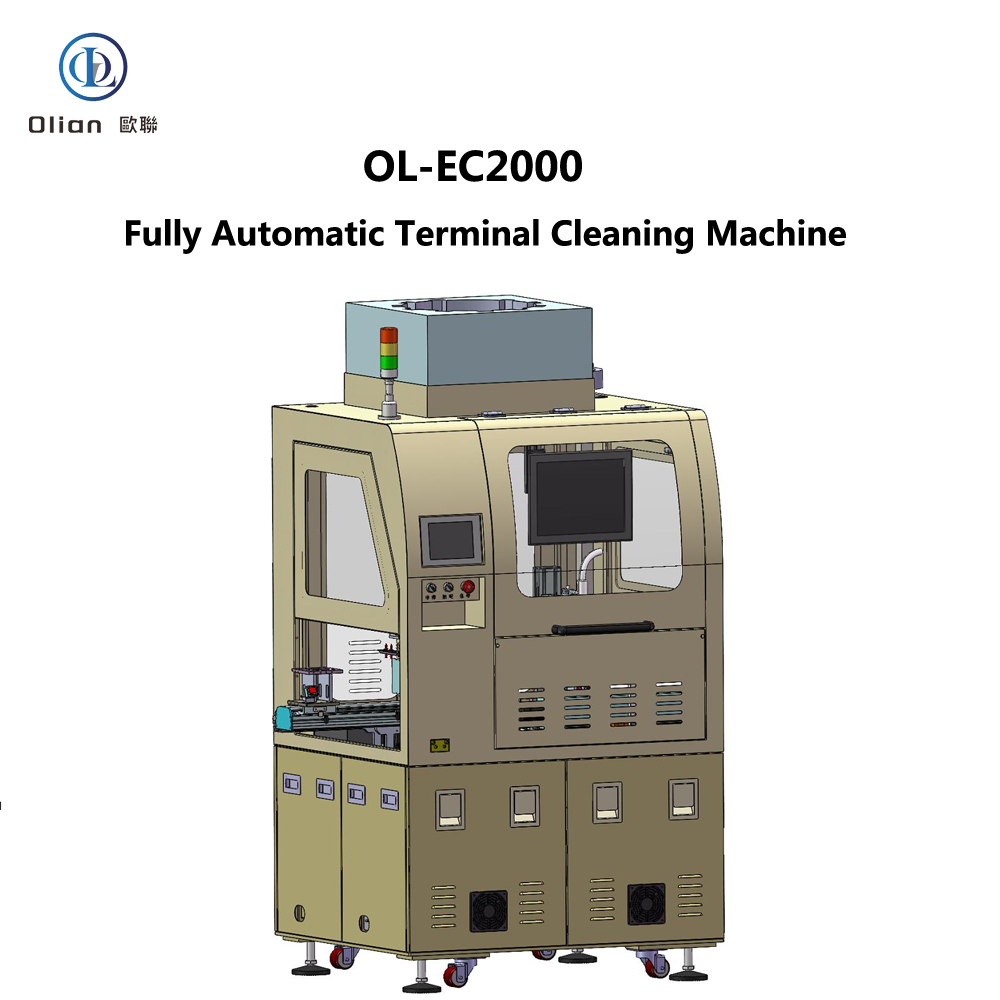
The OL-EC2000 is a cutting-edge fully automatic terminal cleaning machine designed to efficiently clean LCD products of various sizes (1-7 inches) through wiping, cleaning (with optional ultrasonic cleaning), and plasma treatment. This advanced equipment can be integrated with other devices in a production line, making it a valuable addition to modern manufacturing environments where precision and speed are paramount.
Function: Automatically cleans LCD products through wiping, cleaning, and plasma treatment, and can be connected with other equipment for automated production lines.
Working Principle
The OL-EC2000 operates through a series of automated processes. It starts with manual placement of the LCD onto a platform or conveyor belt. Robotic arm 1# then moves the LCD to a CCD correction station for position adjustment. The LCD is transferred to a wiping platform where it is cleaned by a wiping head. After wiping, robotic arm 2# transports the LCD to a plasma cleaning platform for further cleaning. Finally, the cleaned LCD is moved to a discharge station.
End-of-Tape Detection: Sensor detects when the cleaning cloth roll is finished.
Cleaning Air Claw Unit
Air Claw Gap Height: Adjustable via micrometer, travel 5mm.
Air Claw Flatness: Adjustable relative flatness of upper and lower clamping surfaces.
PLAMA Unit
Plasma Cleaning: Low-temperature plasma, measured around 100°C.
Robotic Arms
搬运机械手:
Vacuum nozzles with adjustable numbers and configurations based on product size.
Digital vacuum gauge for real-time monitoring.
X-axis: Servo motor + rail.
Z-axis: Cylinder with manually adjustable position.
θ-axis: Stepper motor.
Stage and Plasma Sections
X-axis Movement: Servo motor + ball screw + rail.
Y-axis Movement: Servo motor + ball screw + rail.
Platform Material: Aluminum with black hard anodizing.
Platform Flatness: ±0.02mm.
Vacuum Suction Circuits: Multiple sets on the platform for different LCD sizes.
Control Unit
Control Method: PLC control.
Touchscreen:
Interface: Chinese, touch-enabled.
Modes: Manual and automatic.
Functions: Parameter display.
Manual Control Buttons:
Emergency Stop Button: 1.
Main Power Switch: 1.
Access Control: Machine pauses when doors are opened during operation.
Operation Indicator Lights: Tri-color lights (customizable to client requirements).
Monitor: Displays visual alignment images.
Documentation and After-sales Service
Documentation: Machine operation manual included.
Training: Covers installation, operation, calibration, maintenance, troubleshooting, and safety precautions.
After-sales Service: One year of free service for non-human-induced faults, with lifelong technical support.
Main Component Brands
Servo and Stepper Motors: Rite (China).
Guideways: SKD (China).
Pneumatic Components: CKD/Airtac (Japan/China).
PLC: Keyence/Panasonic (Japan).
Touchscreen: Proface (Japan).
Power Supply: Mean Well (Taiwan).
Circuit Breakers and Contactors: Shihlin/Schneider (Taiwan).
Drag Chains: Igus (Germany).
In summary, the OL-EC2000 Fully Automatic Terminal Cleaning Machine represents a significant advancement in LCD manufacturing equipment. Its precise engineering, user-friendly design, and comprehensive support make it an ideal choice for manufacturers seeking to enhance productivity and product quality in the competitive electronics market.
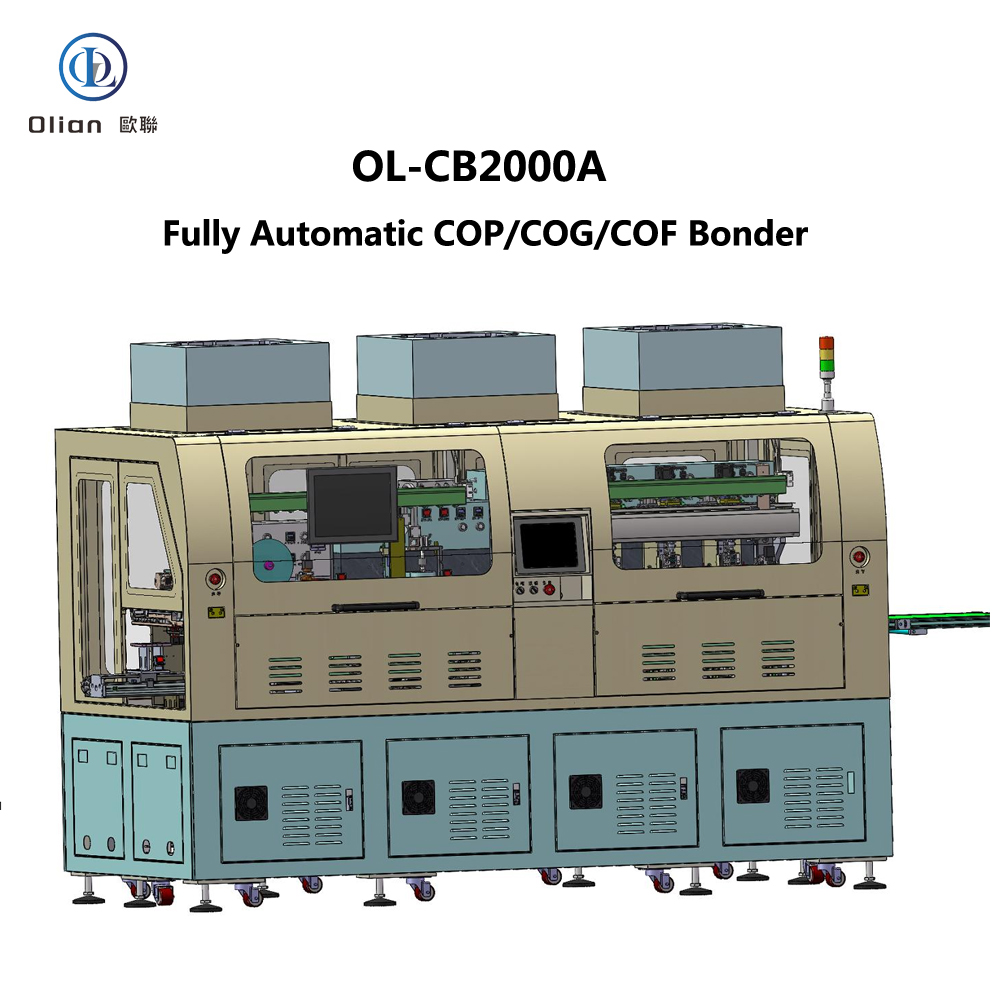
The OL-CB2000A is a state-of-the-art fully automatic COG (Chip on Glass)/COF (Chip on Film) bonder designed to meet the precise requirements of modern electronics manufacturing. This advanced machine is specifically tailored for the automatic ACF (Anisotropic Conductive Film) application, pre-bonding, and main bonding processes of single-sided, single-component LCD products ranging from 1″ to 7″ in size. Its innovative design and high-precision features make it an essential tool for manufacturers seeking efficiency, accuracy, and reliability in their production lines.
OL-CB2000A Fully Automatic COG/COF Bonder
Equipment Information
Equipment Name: Fully Automatic COG/COF Bonder
Model: OL-CB2000A
Application: Suitable for LCD products with sizes from 1″ to 7″, designed for automatic ACF application, pre-bonding, and main bonding of single-sided, single-component products.
Compatibility: Can be integrated with other machines in a production line for seamless operation.
Working Principle
The OL-CB2000A operates through a series of coordinated mechanical and automated processes. The workflow begins with the loading of the product onto the conveyor belt or platform, either manually or via an automated upstream machine. Mechanical arm 1# picks up the LCD, corrects its position using the CCD (Charge-Coupled Device) system, and places it on the ACF platform. The ACF platform advances, and the bonding head descends to apply the ACF. After the ACF application, the platform retracts to the unloading position. Mechanical arm 2# then picks up the LCD, checks the ACF adhesion, and places it on the pre-bonding stage. Meanwhile, the IC/COF is loaded, and the automatic feeding system visually corrects the IC/COF position. After pre-alignment, the IC/COF is moved to the bonding head position, and the bonding head picks it up for pre-bonding. Mechanical arm 3# moves the product to one of the four main bonding platforms for final bonding. Finally, mechanical arm 4# transfers the bonded LCD to the downstream conveyor or production line.
Product Specifications
LCD Specifications
Size Range: Minimum 20mm x 20mm, Maximum 230mm x 120mm, Thickness 0.15mm to 1.1mm.
Alignment Marks: Pitch ≥ 5mm between any two points on the glass, Mark size 200µm to 800µm.
IC/COF Specifications
Terminal Pitch: ≥ 30µm.
Alignment Marks: Pitch 5mm to 70mm.
ACF Specifications
Types: Roll-based, 2-layer or 3-layer.
Application Length: 5mm to 80mm (adjustable based on bonding head length and customer requirements).
Application Width: 0.5mm to 5.0mm.
Reel Specifications: Inner diameter options of 18mm and 25mm, Maximum reel diameter 200mm.
Circuit Breakers and Contactors: Schneider/Shihlin (Taiwan).
Drag Chains: Igus (Germany).
In summary, the OL-CB2000A Fully Automatic COG/COF Bonder represents a significant advancement in the field of LCD manufacturing equipment. Its precise engineering, user-friendly design, and comprehensive support make it an ideal choice for manufacturers seeking to enhance productivity and product quality in the competitive electronics market.
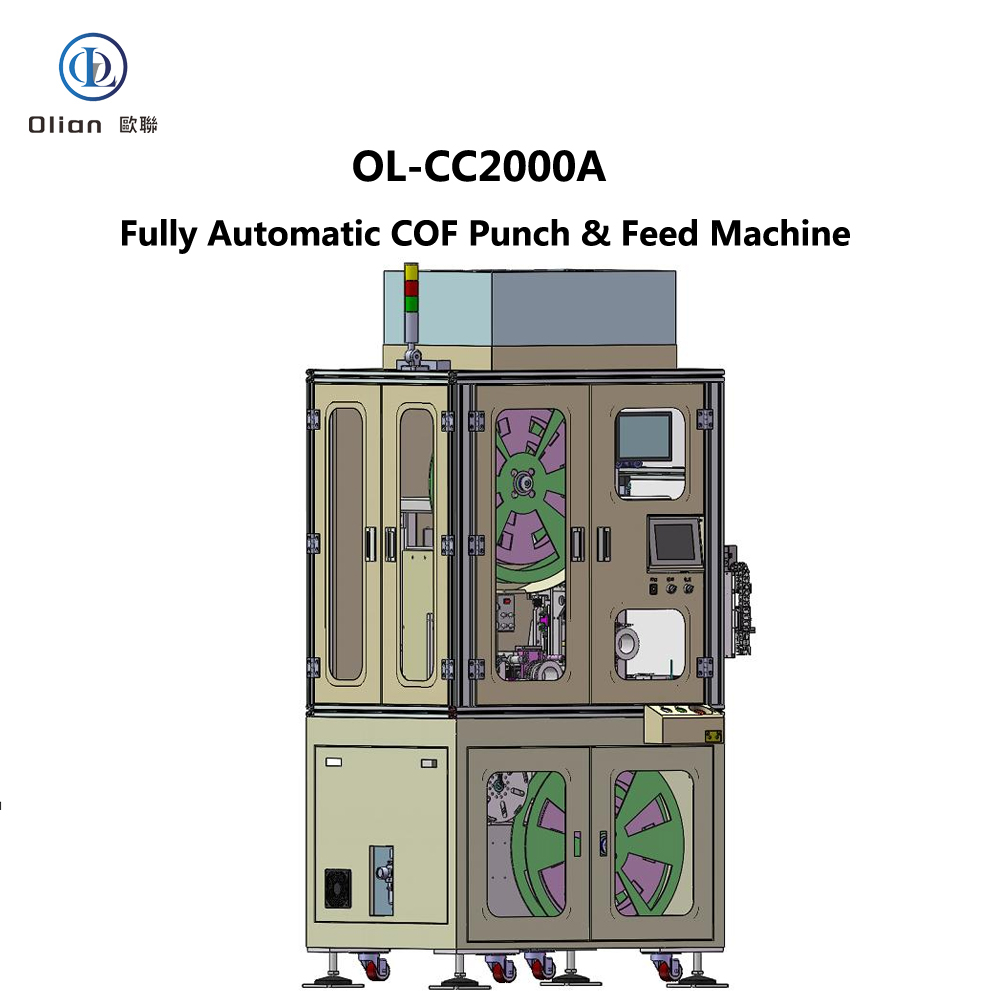
The OL-CC2000A is a highly advanced fully automatic COF (Chip on Film) punching and feeding machine designed to meet the precise requirements of modern electronics manufacturing. This machine specializes in processing COF products with widths of 35mm, 48mm, and 70mm, ensuring accuracy and efficiency in production environments. Its innovative design and robust performance make it an essential addition to manufacturing lines, particularly when integrated with other bonding equipment for automated production.
Application: Designed for COF products with widths of 35mm, 48mm, and 70mm.
Compatibility: Can be integrated with other bonding machines for automated production lines.
Machine Specifications
Physical and Environmental Specifications
Dimensions:
Length: 800mm
Width: 1100mm
Height: 2090mm (excluding FFU)
Weight: Approximately 300kg
Color: Off-white (customizable to client specifications)
Operating Environment: Requires a Class 1000 or lower cleanroom.
Power Supply: Single-phase AC 220V±10%, 50 Hz, with a 2-meter power cord for connection to factory power.
Power Consumption: Maximum 4KW
Air Supply: Clean compressed air with a minimum pressure of 0.5-0.7MPa, consumption approximately 20L/min.
Vacuum Supply: Minimum vacuum degree of -70Kpa (≥ 525mm Hg), flow approximately 20L/min.
Safety Features: Equipped with emergency stop buttons, interlocked design, and audible/visual alarms for errors or operator attention.
Unit Specifications
COF Supply Unit: Motor-driven with belt tensioning mechanism, using ratchet transmission for COF tape feeding. Includes fiber optic detection for COF material presence.
COF Punching and Waste Tape Recovery: Cylinder-driven punching with die cutting, and stepper motor-driven waste tape回收.
COF Cleaning and Transport: Servo motor-driven with screw and rail, featuring anti-static brush and vacuum pickup using soft material.
COF Receiving Platform: Linear motor-driven with vacuum detection.
PUNCH Die: Purchased externally or provided by the user, with a lifespan of approximately 300,000 cycles.
Outfeed Correction CCD: Stepper motor-driven for precise positioning.
Image Processing Unit
COF Punching Camera: Bos视 image processing system with 1 CCD camera, coaxial light LED source, and 4.8mm × 3.6mm field of view.
COF Feeding Correction: Bos视 system with 2 CCD cameras, coaxial light LED source, and 4.8mm × 3.6mm field of view.
Control Unit
Control Method: PLC control with touchscreen interface for manual and automatic modes, displaying work parameters.
Manual Control Buttons: Emergency stop, main power switch.
Access Control: Machine pauses when doors are opened during operation.
Indicator Lights: Tri-color lights for machine status indication.
Documentation and After-sales Service
Documentation: Machine operation manual included.
Training: Covers installation, operation, calibration, maintenance, troubleshooting, and safety precautions.
After-sales Service: One year of free service for non-human-induced faults, with lifelong technical support.
Main Component Brands
Servo Motors: Fuji (Japan)
Ball Screws: Hiwin/THK (China/Japan)
Guideways: Hiwin/THK (China/Japan)
Pneumatic Components: SMC/Airtac (Japan/China)
PLC: Keyence (Japan)
Touchscreen: Proface (Japan)
Sensors: Panasonic/Huan (Japan/China)
Power Supply: Mean Well (Taiwan)
Circuit Breakers and Contactors: Schneider/Shihlin (France/Taiwan)
Drag Chains: Igus (Germany)
In summary, the OL-CC2000A Fully Automatic COF Punch & Feed Machine represents a significant advancement in COF processing equipment. Its precision, reliability, and user-friendly design make it an ideal choice for manufacturers seeking to enhance productivity and product quality in the competitive electronics market.
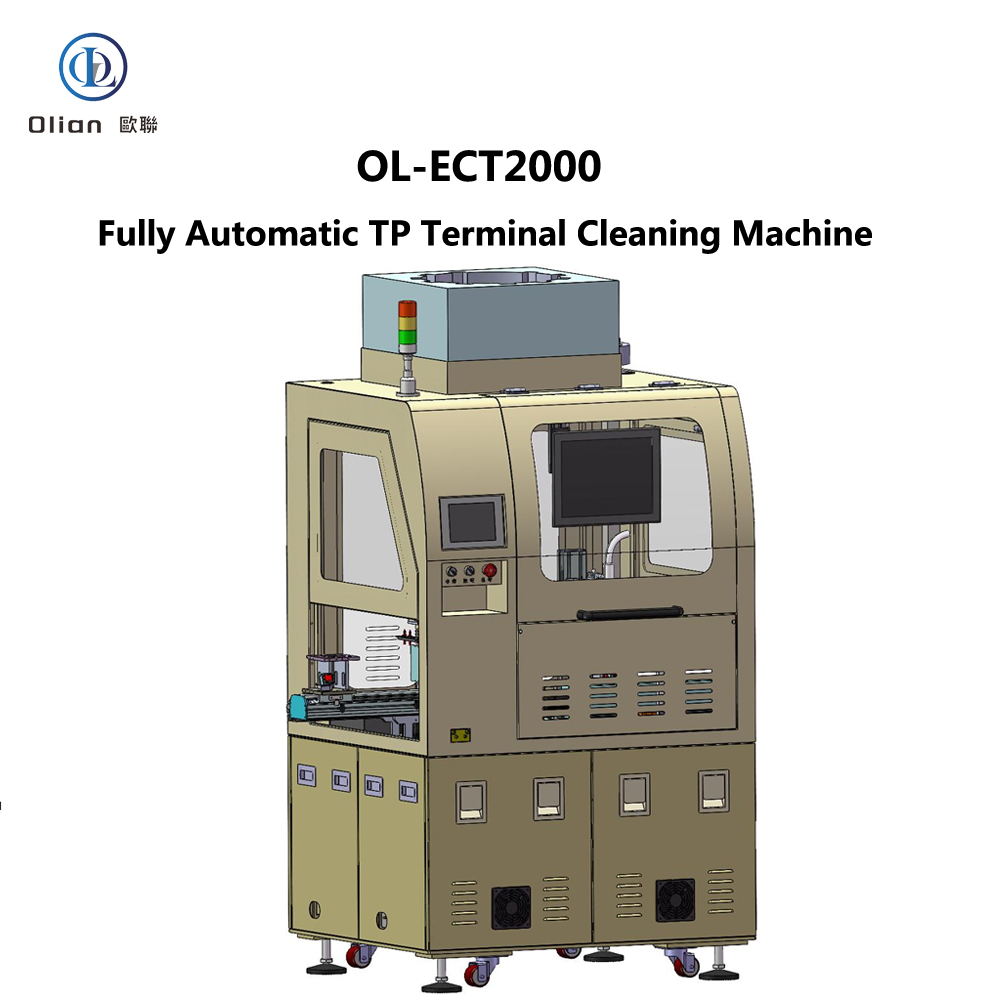
The OL-ECT2000 is a cutting-edge fully automatic terminal cleaning machine designed to efficiently clean LCD products of various sizes (1-7 inches) through wiping, cleaning (with optional ultrasonic cleaning), and plasma treatment. This advanced equipment can be integrated with other devices in a production line, making it a valuable addition to modern manufacturing environments where precision and speed are paramount.
Function: Automatically cleans LCD products through wiping, cleaning, and plasma treatment.
Compatibility: Can be connected with other equipment for automated production lines.
Working Principle
The OL-ECT2000 operates through a series of automated processes. It starts with manual placement of the LCD onto a platform or conveyor belt. Robotic arm 1# then moves the LCD to a CCD correction station for position adjustment. The LCD is transferred to a wiping platform where it is cleaned by a wiping head. After wiping, robotic arm 2# transports the LCD to a plasma cleaning platform for further cleaning. Finally, the cleaned LCD is moved to a discharge station.
End-of-Tape Detection: Sensor detects when the cleaning cloth roll is finished.
Cleaning Air Claw Unit
Air Claw Gap Height: Adjustable via micrometer, travel 5mm.
Air Claw Flatness: Adjustable relative flatness of upper and lower clamping surfaces.
PLAMA Unit
Plasma Cleaning: Low-temperature plasma, measured around 100°C.
Robotic Arms
搬运机械手:
Vacuum nozzles with adjustable numbers and configurations based on product size.
Digital vacuum gauge for real-time monitoring.
X-axis: Servo motor + rail.
Z-axis: Cylinder with manually adjustable position.
θ-axis: Stepper motor.
Stage and Plasma Sections
X-axis Movement: Servo motor + ball screw + rail.
Y-axis Movement: Servo motor + ball screw + rail.
Platform Material: Aluminum with black hard anodizing.
Platform Flatness: ±0.02mm.
Vacuum Suction Circuits: Multiple sets on the platform for different LCD sizes.
Control Unit
Control Method: PLC control.
Touchscreen:
Interface: Chinese, touch-enabled.
Modes: Manual and automatic.
Functions: Parameter display.
Manual Control Buttons:
Emergency Stop Button: 1.
Main Power Switch: 1.
Access Control: Machine pauses when doors are opened during operation.
Operation Indicator Lights: Tri-color lights (customizable to client requirements).
Monitor: Displays visual alignment images.
Documentation and After-sales Service
Documentation: Machine operation manual included.
Training: Covers installation, operation, calibration, maintenance, troubleshooting, and safety precautions.
After-sales Service: One year of free service for non-human-induced faults, with lifelong technical support.
Main Component Brands
Servo and Stepper Motors: Rite (China).
Guideways: SKD (China).
Pneumatic Components: CKD/Airtac (Japan/China).
PLC: Keyence/Panasonic (Japan).
Touchscreen: Proface (Japan).
Power Supply: Mean Well (Taiwan).
Circuit Breakers and Contactors: Shihlin/Schneider (Taiwan).
Drag Chains: Igus (Germany).
In summary, the OL-ECT2000 Fully Automatic TP Terminal Cleaning Machine represents a significant advancement in LCD manufacturing equipment. Its precise engineering, user-friendly design, and comprehensive support make it an ideal choice for manufacturers seeking to enhance productivity and product quality in the competitive electronics market.
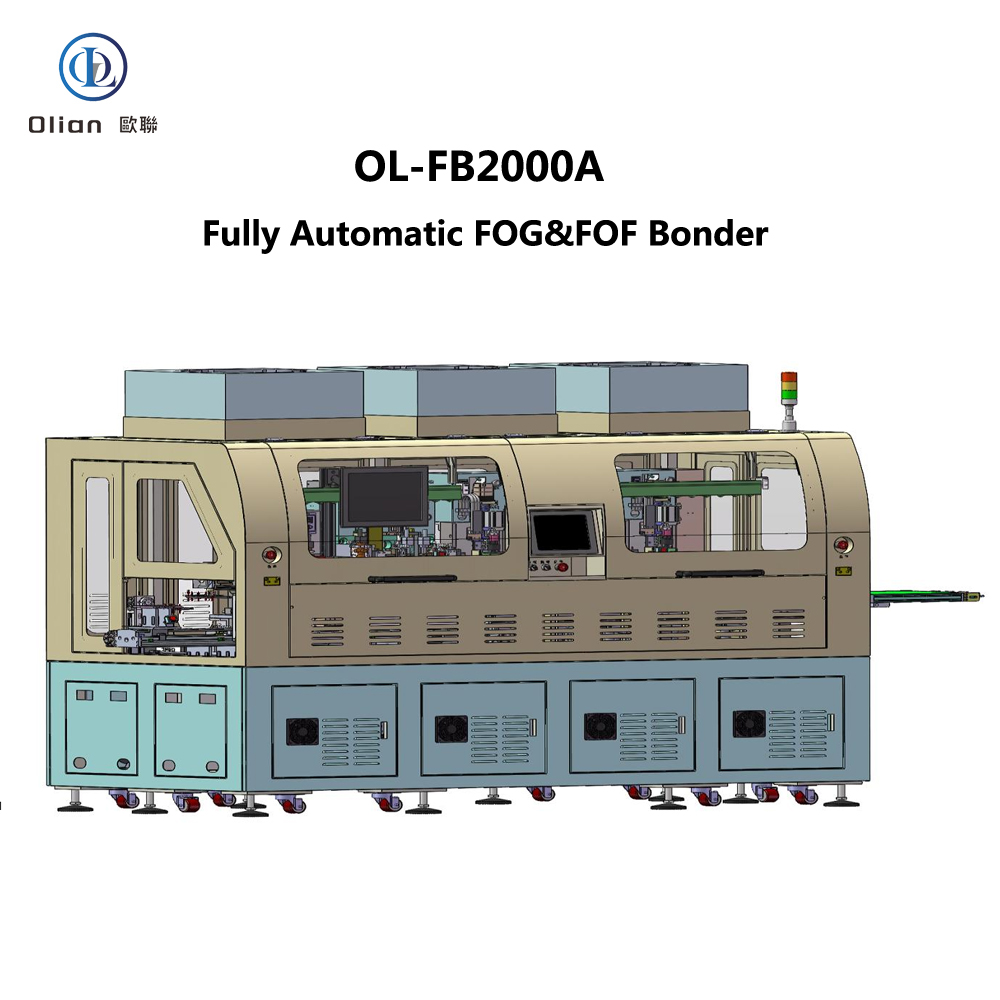
The OL-FB2000A is a cutting-edge fully automatic FOG (FPC/Film on Glass) & FOF (FPC/Film on FPC/Film) bonder designed to meet the precise requirements of modern electronics manufacturing. This advanced machine specializes in automatic ACF (Anisotropic Conductive Film) application, alignment, and thermal bonding for LCD products ranging from 1″ to 7″ in size, with single-sided, single FPC (Flexible Printed Circuit) components. Its innovative design and high-precision features make it an essential tool for manufacturers seeking efficiency, accuracy, and reliability in their production lines.
OL-FB2000A Fully Automatic FOG&FOF Bonder
Equipment Information
Equipment Name: Fully Automatic FOG&FOF Bonder
Model: OL-FB2000A
Application: Suitable for LCD products with sizes from 1″ to 7″, designed for automatic ACF application, alignment, and thermal bonding of single-sided, single FPC.
Compatibility: Can be integrated with other machines in a production line for seamless operation.
Working Principle
The OL-FB2000A operates through a series of coordinated mechanical and automated processes. The workflow begins with the loading of the product onto the conveyor belt or platform, either manually or via an automated upstream machine. Mechanical arm 0# picks up the LCD + COF, corrects its position using the CCD (Charge-Coupled Device) system, and places it on the ACF platform. The ACF platform advances, and the bonding head descends to apply the ACF. After the ACF application, the platform retracts for position detection to ensure proper ACF adhesion.
Next, mechanical arm 1# transfers the LCD + COF to the pre-bonding stage while the FPC is simultaneously loaded and pre-aligned on the carrier stage. The bonding head then picks up the FPC and performs the pre-bonding process. Mechanical arm 2# moves the product to one of the four main bonding platforms for final bonding. Finally, mechanical arm 3# transfers the bonded product to the downstream conveyor or production line.
Product Specifications
LCD Specifications
Size Range: Minimum 20mm x 20mm, Maximum 230mm x 120mm, Thickness 0.15mm to 1.1mm.
Alignment Marks: Pitch ≥ 5mm between any two points on the glass, Mark size 2mm to 100mm.
FPC Specifications
Size Range: Minimum 20mm x 10mm, Maximum 150mm x 122mm, Thickness 0.1mm to 0.5mm.
Terminal Pitch: ≥ 50µm.
Alignment Marks: Pitch 5mm to 70mm.
Note: FPC width is related to the bonding head length and can be customized according to customer requirements.
ACF Specifications
Types: Roll-based, 2-layer or 3-layer.
Application Length: 5mm to 80mm.
Application Width: Available in 0.8mm, 1.0mm, 1.5mm, 2.0mm, and 2.5mm widths, adjustable according to requirements.
Reel Specifications: Inner diameter options of 18mm and 25mm, Maximum reel diameter 200mm.
Width Adjustment: Manual width adjustment with limit wheel.
Sensor detection for tape end monitoring.
Image Processing Unit
LCD Correction:
System: Bos视 image processing system.
CCD Camera: 1.
Coaxial Light Barrel: 1.
Magnification: 1x.
Field of View: 4.8mm × 3.6mm.
Light Source: Coaxial light LED.
Z-axis Adjustable Travel: 10mm.
ACF Inspection:
System: Bos视 detection system.
CCD: 1.
Coaxial Light Barrel: 1.
Magnification: 0.5x.
Field of View: 9.6mm × 7.2mm.
Light Source: Coaxial light LED.
Pre-bonding Alignment:
System: Bos视 image processing system.
CCD Cameras: 2.
Coaxial Light Barrels: 2.
Magnification: 2x.
Field of View: 2.4mm × 1.8mm.
Light Source: Coaxial light LED.
Alignment Method: Mark coincidence.
Main Bonding Alignment:
System: Bos视 image processing system.
CCD Camera: 1.
Coaxial Light Barrel: 1.
Magnification: 1x.
Field of View: 4.8mm × 3.6mm.
Light Source: Coaxial light LED.
Z-axis Adjustable Travel: 10mm.
Control Unit
Control Method: PLC control.
Touchscreen:
Interface: Chinese, touch-enabled.
Modes: Manual and automatic.
Functions: Parameter display, data storage for 100 varieties.
Manual Control Buttons:
Emergency Stop Buttons: 3.
Main Power Switch: 1.
Lighting Power Switch: 1.
Access Control: Machine pauses when doors are opened during operation.
Operation Indicator Lights: Tri-color lights.
Documentation and After-sales Service
Documentation: Machine operation manual included.
Training: Covers installation, operation, calibration, maintenance, troubleshooting, and safety precautions.
After-sales Service: One year of free service for non-human-induced faults, with lifelong technical support.
Main Component Brands
Servo Motors: Fuji (except for robot arm Z-axis) / Rite (robot arm Z-axis) (Japan/China).
Ball Screws: Hiwin/THK (China/Japan).
DDR: NSK (Japan).
Guideways: Hiwin/THK (China/Japan).
Pneumatic Components: SMC/Airtac (Japan/China).
PLC: Keyence (Japan).
Touchscreen: Proface (Japan).
Sensors: Panasonic/Huan (Japan/China).
Power Supply: Mean Well (Taiwan).
Circuit Breakers and Contactors: Schneider/Shihlin (Taiwan).
Drag Chains: Igus (Germany).
In summary, the OL-FB2000A Fully Automatic FOG&FOF Bonder represents a significant advancement in the field of LCD manufacturing equipment. Its precise engineering, user-friendly design, and comprehensive support make it an ideal choice for manufacturers seeking to enhance productivity and product quality in the competitive electronics market.
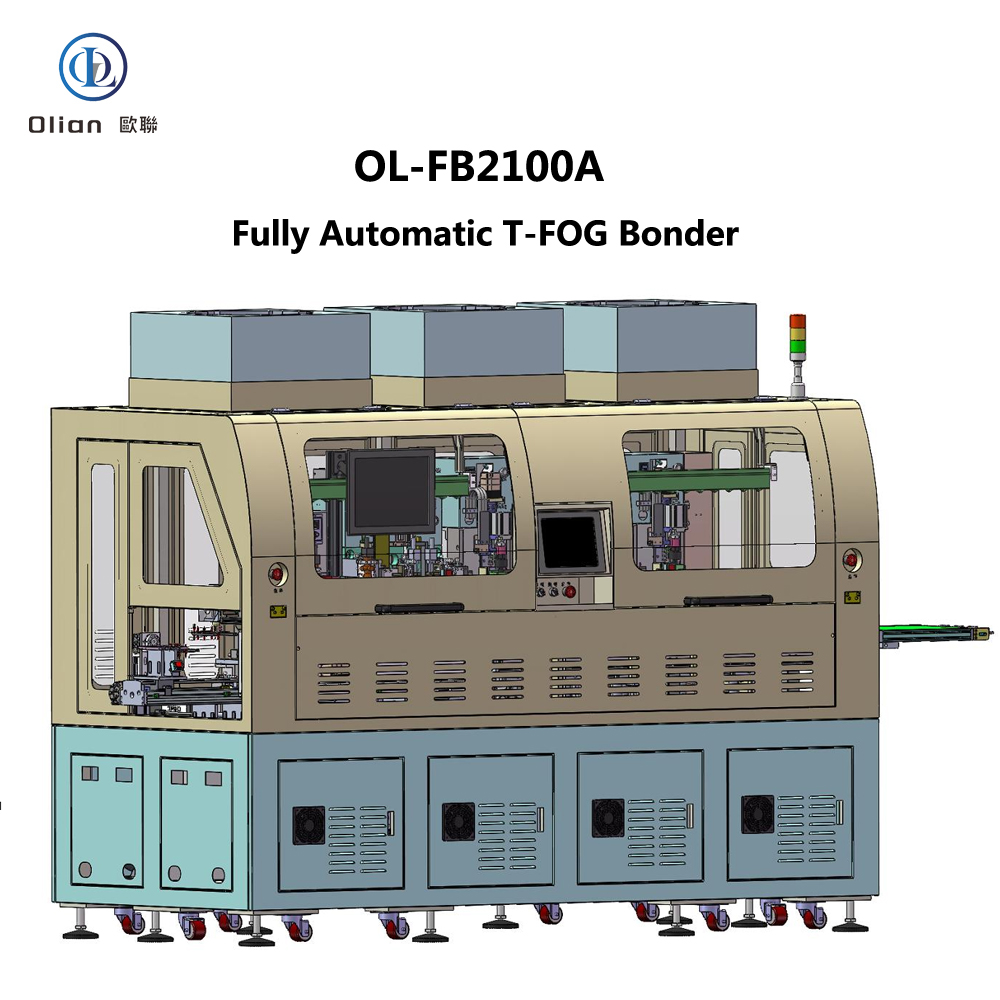
The OL-FB2100A is a cutting-edge fully automatic T-FOG (Tape Film on Glass) bonder designed to meet the precise requirements of modern electronics manufacturing. This advanced machine specializes in automatic ACF (Anisotropic Conductive Film) application, alignment, and thermal bonding for LCD products ranging from 1″ to 7″ in size, with single-sided, single FPC (Flexible Printed Circuit) components. Its innovative design and high-precision features make it an essential tool for manufacturers seeking efficiency, accuracy, and reliability in their production lines.
OL-FB2100A Fully Automatic T-FOG Bonder
Equipment Information
Equipment Name: Fully Automatic T-FOG Bonder
Model: OL-FB2100A
Application: Suitable for LCD products with sizes from 1″ to 7″, designed for automatic ACF application, alignment, and thermal bonding of single-sided, single FPC.
Compatibility: Can be integrated with other machines in a production line for seamless operation.
Working Principle
The OL-FB2100A operates through a series of coordinated mechanical and automated processes. The workflow begins with the loading of the product onto the conveyor belt or platform, either manually or via an automated upstream machine. Mechanical arm 0# picks up the LCD + COF, corrects its position using the CCD (Charge-Coupled Device) system, and places it on the ACF platform. The ACF platform advances, and the bonding head descends to apply the ACF. After the ACF application, the platform retracts for position detection to ensure proper ACF adhesion.
Next, mechanical arm 1# transfers the LCD + COF to the pre-bonding stage while the FPC is simultaneously loaded and pre-aligned on the carrier stage. The bonding head then picks up the FPC and performs the pre-bonding process. Mechanical arm 2# moves the product to one of the four main bonding platforms for final bonding. Finally, mechanical arm 3# transfers the bonded product to the downstream conveyor or production line.
Product Specifications
LCD Specifications
Size Range: Minimum 20mm x 20mm, Maximum 230mm x 120mm, Thickness 0.15mm to 1.1mm.
Alignment Marks: Pitch ≥ 5mm between any two points on the glass, Mark size 2mm to 100mm.
FPC Specifications
Size Range: Minimum 20mm x 10mm, Maximum 150mm x 122mm, Thickness 0.1mm to 0.5mm.
Terminal Pitch: ≥ 50µm.
Alignment Marks: Pitch 5mm to 70mm.
Note: FPC width is related to the bonding head length and can be customized according to customer requirements.
ACF Specifications
Types: Roll-based, 2-layer or 3-layer.
Application Length: 5mm to 80mm.
Application Width: Available in 0.8mm, 1.0mm, 1.5mm, 2.0mm, and 2.5mm widths, adjustable according to requirements.
Reel Specifications: Inner diameter options of 18mm and 25mm, Maximum reel diameter 200mm.
Width Adjustment: Manual width adjustment with limit wheel.
Sensor detection for tape end monitoring.
Image Processing Unit
LCD Correction:
System: Bos视 image processing system.
CCD Camera: 1.
Coaxial Light Barrel: 1.
Magnification: 1x.
Field of View: 4.8mm × 3.6mm.
Light Source: Coaxial light LED.
Z-axis Adjustable Travel: 10mm.
ACF Inspection:
System: Bos视 detection system.
CCD: 1.
Coaxial Light Barrel: 1.
Magnification: 0.5x.
Field of View: 9.6mm × 7.2mm.
Light Source: Coaxial light LED.
Pre-bonding Alignment:
System: Bos视 image processing system.
CCD Cameras: 2 & 4.
Coaxial Light Barrels: 2 & 4.
Magnification: 2x.
Field of View: 2.4mm × 1.8mm.
Light Source: Coaxial light LED.
Alignment Method: Mark coincidence & four-phase correlation alignment.
Main Bonding Alignment:
System: Bos视 image processing system.
CCD Camera: 1.
Coaxial Light Barrel: 1.
Magnification: 1x.
Field of View: 4.8mm × 3.6mm.
Light Source: Coaxial light LED.
Z-axis Adjustable Travel: 10mm.
Control Unit
Control Method: PLC control.
Touchscreen:
Interface: Chinese, touch-enabled.
Modes: Manual and automatic.
Functions: Parameter display, data storage for 100 varieties.
Manual Control Buttons:
Emergency Stop Buttons: 3.
Main Power Switch: 1.
Lighting Power Switch: 1.
Access Control: Machine pauses when doors are opened during operation.
Operation Indicator Lights: Tri-color lights.
Documentation and After-sales Service
Documentation: Machine operation manual included.
Training: Covers installation, operation, calibration, maintenance, troubleshooting, and safety precautions.
After-sales Service: One year of free service for non-human-induced faults, with lifelong technical support.
Main Component Brands
Servo Motors: Fuji (except for robot arm Z-axis) / Rite (robot arm Z-axis) (Japan/China).
Ball Screws: Hiwin/THK (China/Japan).
DDR: NSK (Japan).
Guideways: Hiwin/THK (China/Japan).
Pneumatic Components: SMC/Airtac (Japan/China).
PLC: Keyence (Japan).
Touchscreen: Proface (Japan).
Sensors: Panasonic/Huan (Japan/China).
Power Supply: Mean Well (Taiwan).
Circuit Breakers and Contactors: Schneider/Shihlin (Taiwan).
Drag Chains: Igus (Germany).
In summary, the OL-FB2100A Fully Automatic T-FOG Bonder represents a significant advancement in the field of LCD manufacturing equipment. Its precise engineering, user-friendly design, and comprehensive support make it an ideal choice for manufacturers seeking to enhance productivity and product quality in the competitive electronics market.
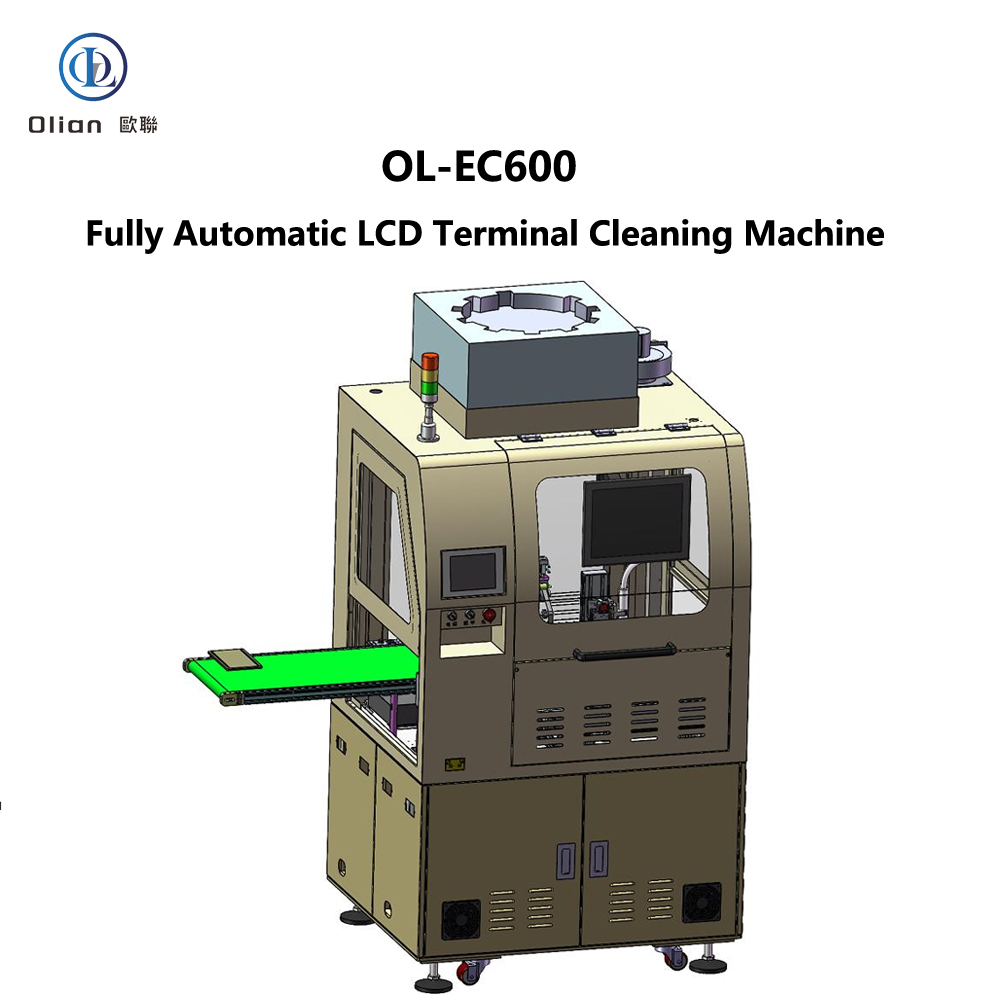
The EC-600 is a highly efficient fully automatic LCD terminal cleaning machine designed to perform wiping, cleaning, and plasma treatment for LCD products of various sizes (from 20mm x 20mm to 150mm x 90mm). This advanced machine can be integrated with other devices in a production line, making it a valuable addition to modern manufacturing environments where precision and speed are critical.
Function: Cleans LCD products through wiping, cleaning, and plasma treatment.
Compatibility: Can be connected with other equipment for automated production lines.
Working Principle
The EC-600 operates through a series of automated processes. It starts with manual placement of the LCD onto a platform or conveyor belt. Robotic arm 1# picks up the LCD, corrects its position using the CCD (Charge-Coupled Device) system, and places it on the wiping platform. The platform then moves the LCD to the cleaning head for cleaning. After wiping, robotic arm 2# transports the LCD to a plasma cleaning platform for further cleaning. Finally, the cleaned LCD is moved to a discharge station.
Product Specifications
LCD Specifications
Size Range: Minimum 20mm x 20mm, Maximum 150mm x 90mm, Thickness 0.15mm to 1.1mm.
Cleaning Cloth Specifications
Type: Roll-based (number of rolls: 2).
Width: ≤ 10mm.
Maximum Roll Diameter: ≤ 300mm.
Roll Inner Hole Diameter: ≥ 24.5mm.
Feed Length: Adjustable from 0.1mm to 99.9mm.
Cleaning Solvent
Type: Alcohol or acetone.
Machine Performance
Production Cycle
Cycle Time: 3.5 seconds per piece for screens up to 4 inches, and 4.2 seconds per piece for screens between 4 and 6.5 inches.
Handling Precision
Precision: ±0.1mm.
Water Drop Angle
Water Drop Angle: ≤ 15 degrees, depending on actual conditions.
Product Type
Supported Type: Single-edge terminal face cleaning.
Model Changeover
New Model Setup: ≤ 30 minutes.
Existing Model Recall: ≤ 15 minutes, depending on the operator’s proficiency.
Linear Motors: Yakobes/Linea/Dongxin (China/China/China).
Ball Screws: THK/Hiwin/TBI (Japan/China/China).
Guideways: THK/Hiwin/TBI (Japan/China/China).
Pneumatic Components: SMC/Airtac (Japan/China).
PLC: Panasonic (Japan).
Touchscreen: Proface/Weilin (Japan/China).
Sensors: Panasonic/Huan (Japan/China).
Power Supply: Mean Well (China).
Circuit Breakers and Contactors: Schneider/Shihlin/Chint (China).
Drag Chains: Igus (Germany).
In summary, the EC-600 Fully Automatic LCD Terminal Cleaning Machine represents a significant advancement in LCD manufacturing equipment. Its precise engineering, user-friendly design, and comprehensive support make it an ideal choice for manufacturers seeking to enhance productivity and product quality in the competitive electronics market.
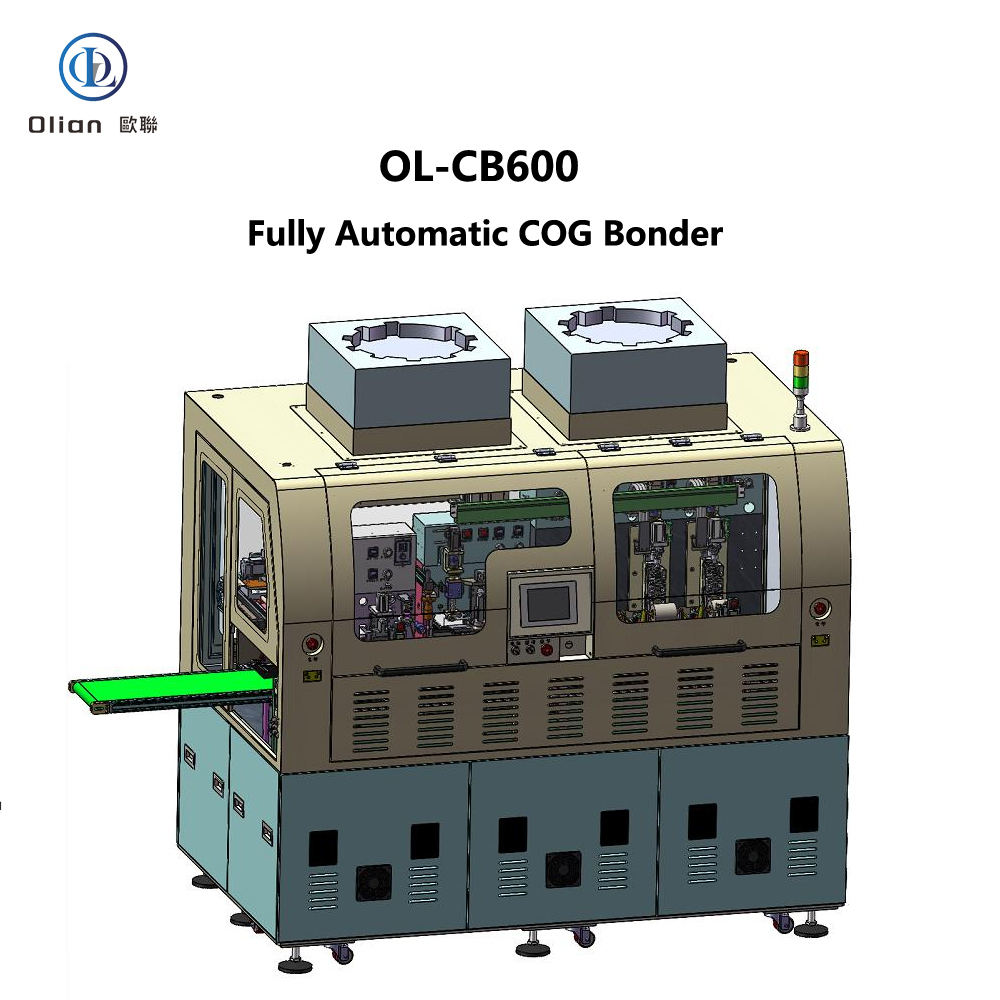
The CB-600 is a cutting-edge fully automatic COG (Chip on Glass) bonder designed to meet the precise requirements of modern electronics manufacturing. This advanced machine specializes in automatic ACF (Anisotropic Conductive Film) application, pre-bonding, and main bonding processes for LCD products ranging from 1″ to 6.5″ in size, with single-sided, single IC components. Its innovative design and high-precision features make it an essential tool for manufacturers seeking efficiency, accuracy, and reliability in their production lines.
CB-600 Fully Automatic COG Bonder
Equipment Information
Equipment Name: Fully Automatic COG Bonder
Model: CB-600
Application: Suitable for LCD products with sizes from 1″ to 6.5″, designed for automatic ACF application, pre-bonding, and main bonding of single-sided, single IC.
Compatibility: Can be integrated with other machines in a production line for seamless operation.
Working Principle
The CB-600 operates through a series of coordinated mechanical and automated processes. The workflow begins with the loading of the product onto the conveyor belt or platform, either manually or via an automated upstream machine. Mechanical arm 1# picks up the product, corrects its position using the CCD (Charge-Coupled Device) system, and places it on the ACF platform. The ACF platform advances, and the bonding head descends to apply the ACF. After the ACF application, the platform retracts for position detection to ensure proper ACF adhesion. Mechanical arm 3# then picks up the LCD, checks the ACF adhesion, and places it on the pre-bonding stage. Meanwhile, the IC is loaded, and the automatic feeding system visually corrects the IC position. After pre-alignment, the IC is moved to the bonding head position, and the bonding head picks it up for pre-bonding. Mechanical arm 4# moves the product to one of the three main bonding platforms for final bonding. Finally, mechanical arm 5# transfers the bonded product to the downstream conveyor or production line.
Product Specifications
LCD Specifications
Size Range: Minimum 20mm x 20mm, Maximum 150mm x 90mm, Thickness 0.15mm to 1.1mm.
Alignment Marks: Pitch ≥ 5mm between any two points on the glass, Mark size 200µm to 1000µm.
IC Specifications
Terminal Pitch: ≥ 30µm.
Alignment Marks: Pitch 5mm to 70mm.
ACF Specifications
Types: Roll-based, 2-layer or 3-layer.
Application Length: 5mm to 80mm (adjustable based on bonding head length and customer requirements).
Application Width: 0.5mm to 5.0mm.
Reel Specifications: Inner diameter options of 18mm and 25mm, Maximum reel diameter 200mm.
Linear Motors: Yakobes/Linea/Dongxin (China/China/China).
Ball Screws: THK/Hiwin/TBI (Japan/China/China).
Guideways: THK/Hiwin/TBI (Japan/China/China).
Pneumatic Components: SMC/Airtac (Japan/China).
PLC: Keyence (Japan).
Touchscreen: Proface (Japan).
Sensors: Panasonic/Huan (Japan/China).
Power Supply: Mean Well (China).
Circuit Breakers and Contactors: Schneider/Shihlin/Chint (China).
Drag Chains: Igus (Germany).
In summary, the CB-600 Fully Automatic COG Bonder represents a significant advancement in the field of LCD manufacturing equipment. Its precise engineering, user-friendly design, and comprehensive support make it an ideal choice for manufacturers seeking to enhance productivity and product quality in the competitive electronics market.
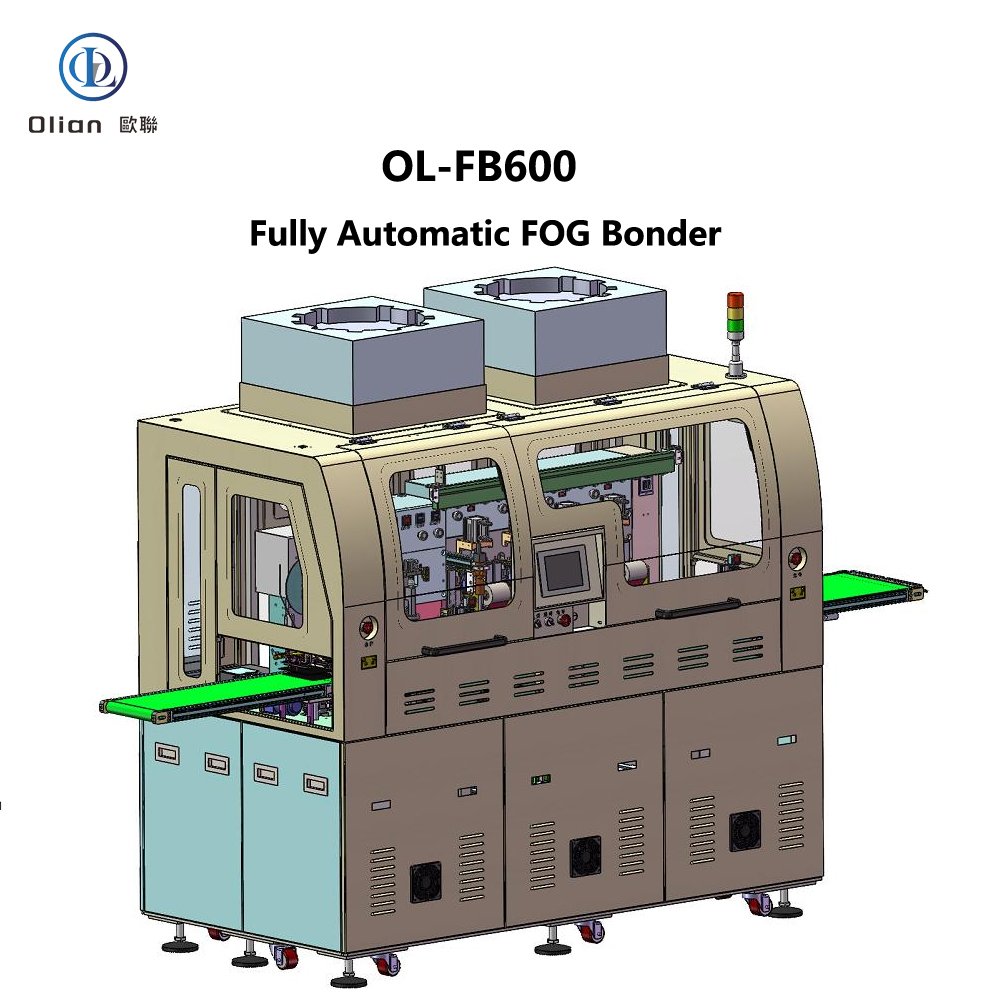
The FB-600 Fully Automatic FOG (Film on Glass) Bonder is a cutting-edge device designed for the manufacturing of LCD products. This machine is specifically tailored for 1″-6.5″ vertical screen LCD products, handling single-edge, single-segment ACF (Anisotropic Conductive Film) attachment, pre-bonding, and main bonding processes. It can be integrated with other production line equipment for seamless manufacturing operations.
2. Equipment Information
Equipment Name: Fully Automatic FOG Bonder
Model: FB-600
Application: Suitable for LCD products with sizes from 1″ to 6.5″, designed for automatic ACF application, pre-bonding, and main bonding of single-sided, single FPC (Flexible Printed Circuit).
Compatibility: Can be integrated with other machines in a production line for seamless operation.
3. Working Principle
The FB-600 operates through a series of coordinated mechanical and automated processes:
Feeding: Components are fed via conveyor belts or platforms, either manually or automatically from connected machines.
Positioning: A robotic arm (Mechanical Hand 1) picks up the LCD, which is then corrected in position using CCD (Charge-Coupled Device) technology before being placed on the ACF platform.
ACF Application: The ACF platform advances, the pressing head descends to apply the ACF, and then retreats for position verification and ACF attachment quality inspection.
Pre-bonding: Another robotic arm (Mechanical Hand 2) places the LCD on the pre-bonding platform while the FPC is simultaneously positioned. The pressing head then performs the pre-bonding.
Main Bonding: Mechanical Hand 3 transfers the product to four main bonding platforms for final bonding, after which Mechanical Hand 4 moves the finished product to the downstream platform or conveyor belt.
4. Product Specifications
LCD Specifications
Size Range: Minimum 20mm x 20mm, Maximum 150mm x 90mm, Thickness 0.15mm to 1.1mm.
Alignment Marks: Pitch ≥ 5mm between any two points on the glass, Mark size 200µm to 1000µm.
FPC Specifications
Size Range: Minimum 20mm x 10mm, Maximum 150mm x 80mm, Thickness 0.1mm to 0.5mm.
Terminal Pitch: ≥ 50µm.
Alignment Marks: Pitch 5mm to 70mm.
ACF Specifications
Types: Roll-based, 2-layer or 3-layer.
Application Length: 5mm to 80mm (adjustable based on bonding head length and customer requirements).
Application Width: 0.8mm to 2.5mm.
Reel Specifications: Inner diameter options of 18mm and 25mm, Maximum reel diameter 200mm.
Linear Motors: Yakobes/Linea/Dongxin (China/China/China).
Ball Screws: THK/Hiwin/TBI (Japan/China/China).
Guideways: THK/Hiwin/TBI (Japan/China/China).
Pneumatic Components: SMC/Airtac (Japan/China).
PLC: Keyence (Japan).
Touchscreen: Proface (Japan).
Sensors: Panasonic/Huan (Japan/China).
Power Supply: Mean Well (China).
Circuit Breakers and Contactors: Schneider/Shihlin/Chint (China).
Drag Chains: Igus (Germany).
In summary, the FB-600 Fully Automatic FOG Bonder represents a significant advancement in the field of LCD manufacturing equipment. Its precise engineering, user-friendly design, and comprehensive support make it an ideal choice for manufacturers seeking to enhance productivity and product quality in the competitive electronics market.
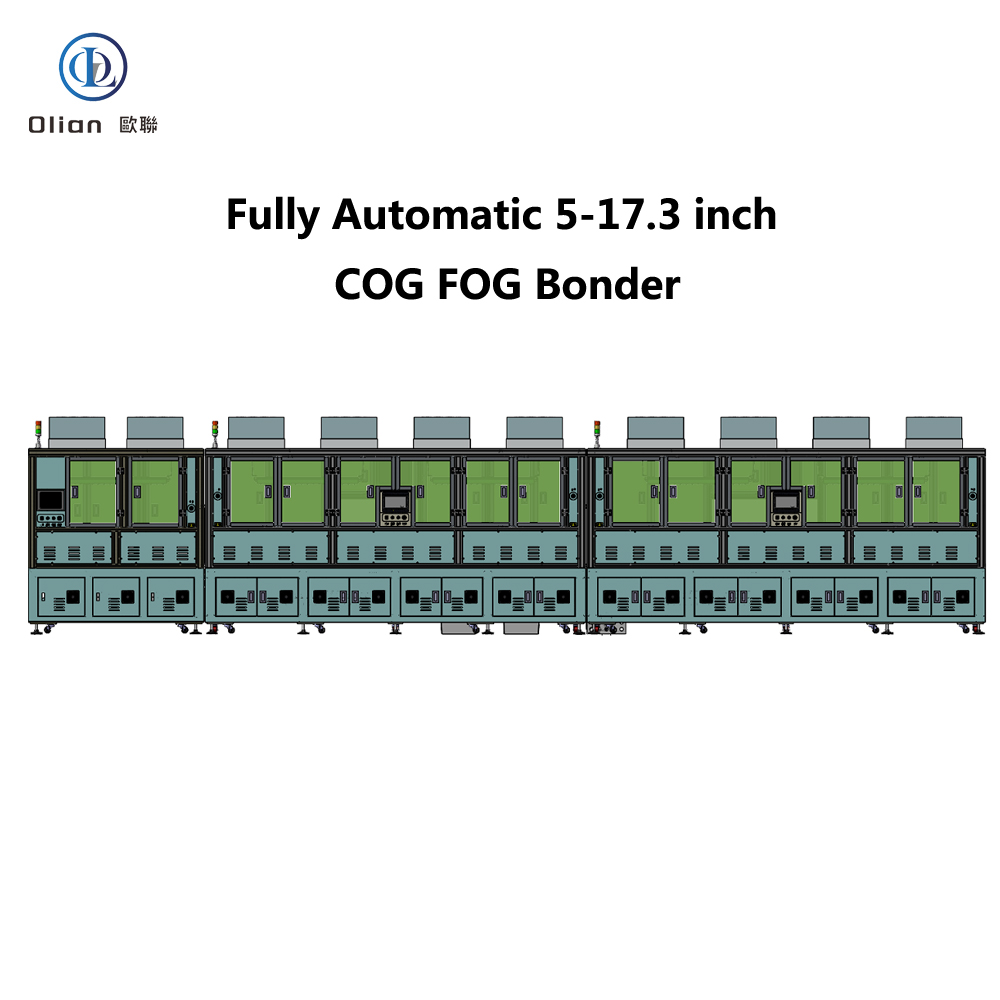
This document presents a comprehensive automation solution for the production of mid-size display modules (5-17.3 inches), focusing on the integration of various equipment for high-precision and high-efficiency manufacturing. The solution includes panel loading, terminal cleaning, COG (Chip on Glass) and FOG (FPC on Glass) bonding, as well as FPC (Flexible Printed Circuit) feeding. Each component is designed to work seamlessly with others to ensure smooth production flow and superior product quality.
Equipment Overview
1. Panel Loading Machine (LLD3000)
Panel Size Range: 5″ to 17.3″ (MIN: 80×80 mm, MAX: 380×380 mm)
Thickness: 0.15–0.7 mm
Tack Time: ≤4 seconds for 7″ panels (non-stop loading)
Vacuum & Air Supply: Compatible with customer-provided vacuum or standalone pump
Plasma Parameters: Power 120-200W, temperature 60-100°C
Features: Visual correction, ACF detection, and dual-sided cleaning capability
Power: 220V/50Hz, 3KW
Dimensions: 1800(L) × 1200(W) × 1900(H) mm
3. Fully Automatic COG Bonding Machine (CB3000)
Panel Size Range: 5″ to 17.3″
Tack Time:
≤6.5 seconds for single IC (dual-panel mode)
≤9 seconds for dual ICs (single-panel mode)
Precision:
ACF: X±0.15mm/Y±0.1mm (3σ)
Main Press: X/Y±5um (3σ)
IC Supply: Dual feeders for non-stop loading
Power: Three-phase, 380V, 12.5KW
Dimensions: ~4080(L) × 1600(W) × 1900(H) mm
4. Fully Automatic FOG Bonding Machine (FB3000)
Panel Size Range: 5″ to 17.3″
Tack Time:
≤6.5 seconds for single FPC (non-Y type)
≤10 seconds for dual FPCs
Precision:
ACF: X±0.15mm/Y±0.1mm (3σ)
Main Press: Single-segment FPC: X/Y±15um (3σ); U-shaped FPC: X/Y±20um (3σ)
FPC Supply: Single or dual channels for flexible loading
Power: Three-phase, 380V, 10KW
Dimensions: ~4000(L) × 1470(W) × 1900(H) mm
5. Fully Automatic FPC Loading Machine (FLD3000)
FPC Size Range: MIN: 15×10mm, MAX: 100×175mm
Tack Time: ≤4 seconds for same FPC, ≤6 seconds for dual FPCs
Precision: ±0.03mm
Power: Single-phase, 220V, 3.5KW
Dimensions: ~1100(L) × 1450(W) × 1900(H) mm
Process Flow
Panel Loading: Panels are loaded automatically with precise handling.
Terminal Cleaning: Terminals are cleaned using IPA and plasma to ensure contamination-free surfaces.
ACF Application: ACF material is applied precisely onto the glass or FPC.
IC/FPC Bonding: ICs or FPCs are aligned and bonded onto the glass using COG or FOG processes.
AOI Inspection: Products undergo automated optical inspection to ensure quality.
Key Features
High Precision: Ensures accurate alignment and bonding for superior product quality.
Automation: Reduces manual intervention, minimizing errors and improving efficiency.
Versatility: Compatible with various panel sizes and FPC configurations.
Reliability: Robust construction and high-quality components ensure consistent performance.
Conclusion
This automation solution for mid-size display modules offers a comprehensive approach to efficient and precise manufacturing. By integrating advanced technologies and equipment, it ensures high yield, superior quality, and cost-effectiveness, making it ideal for modern display production environments.