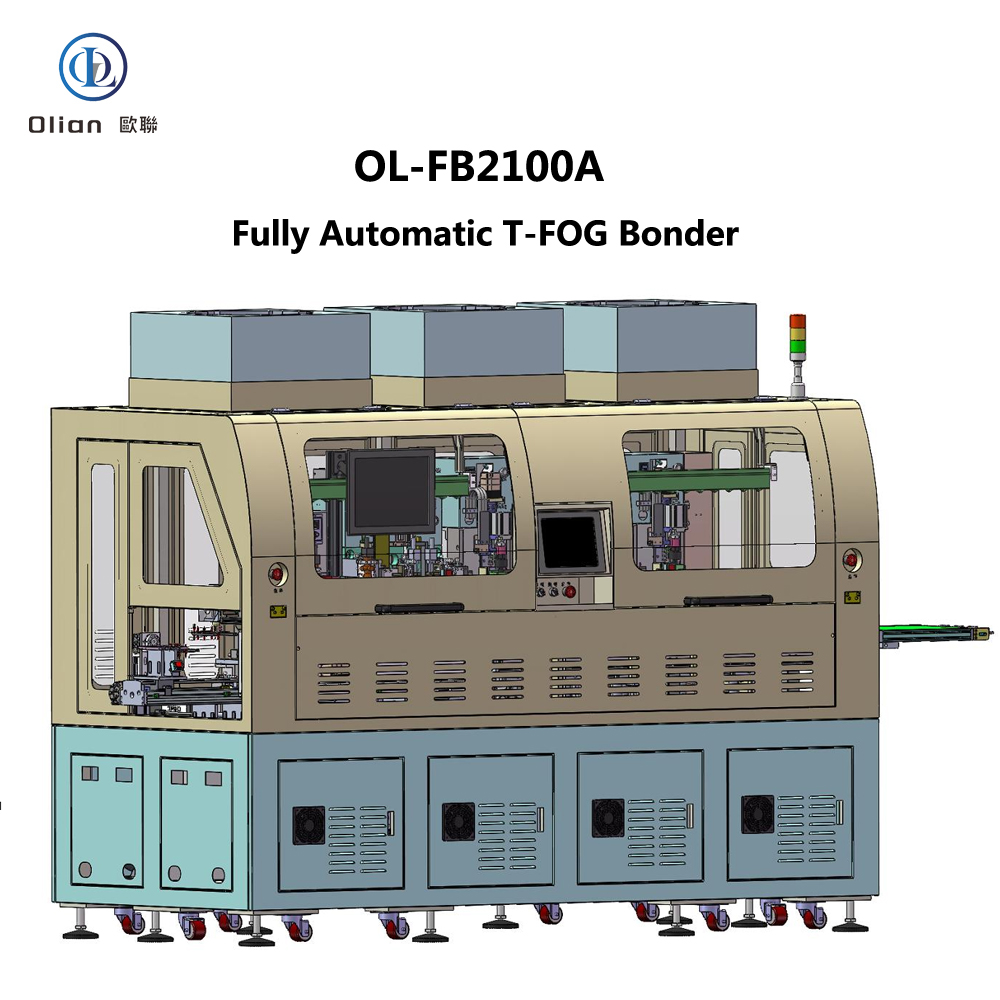
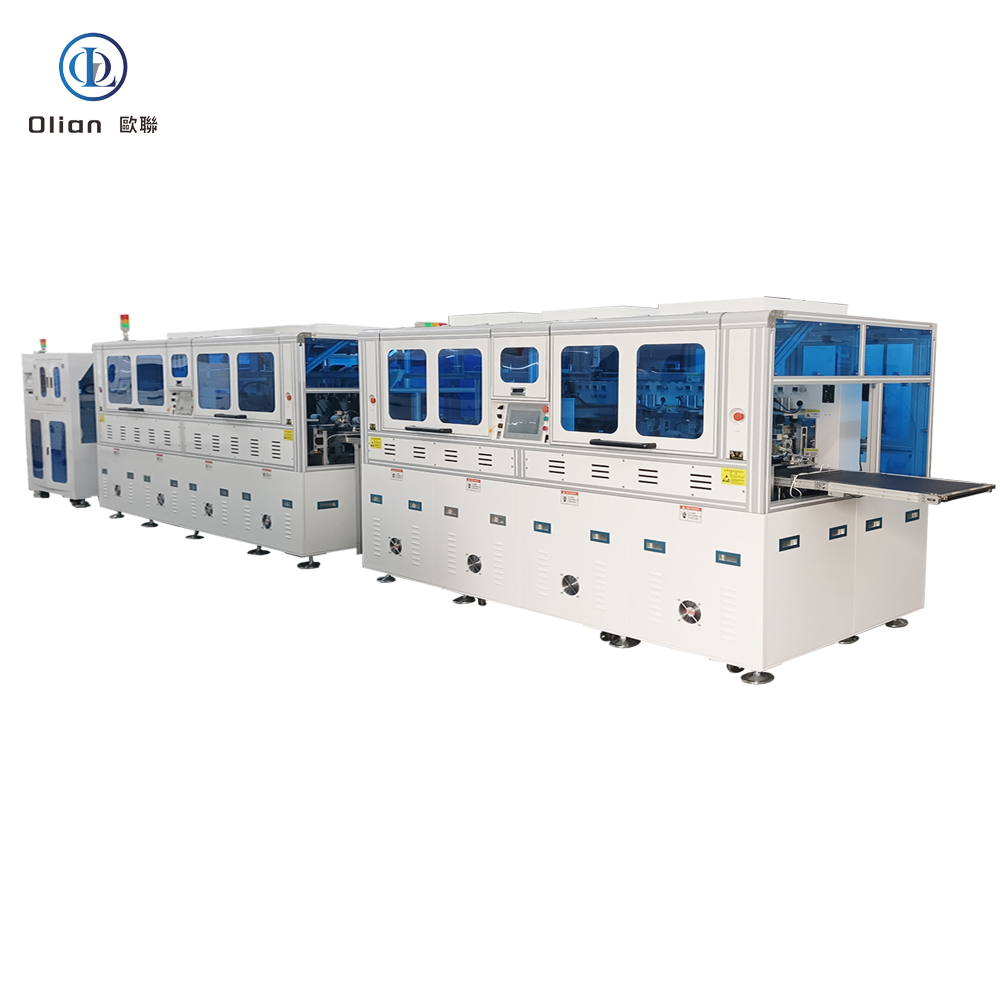
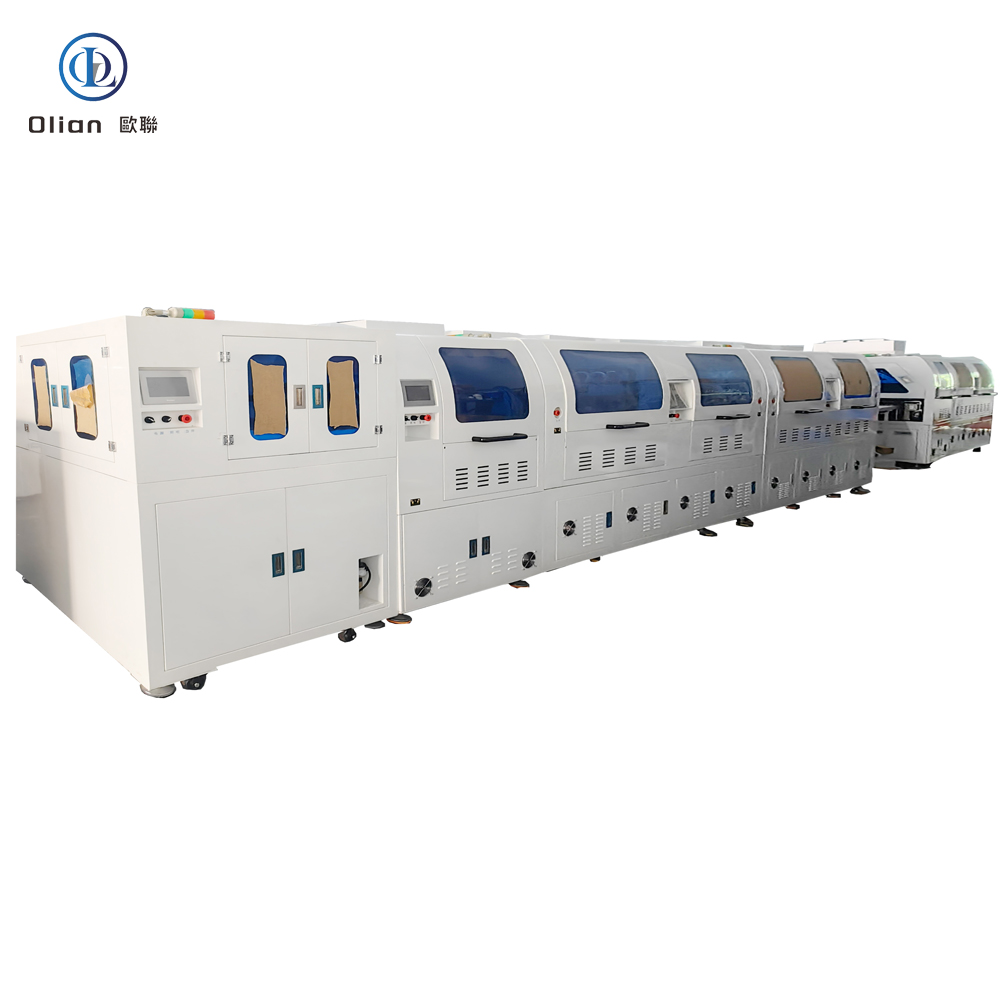
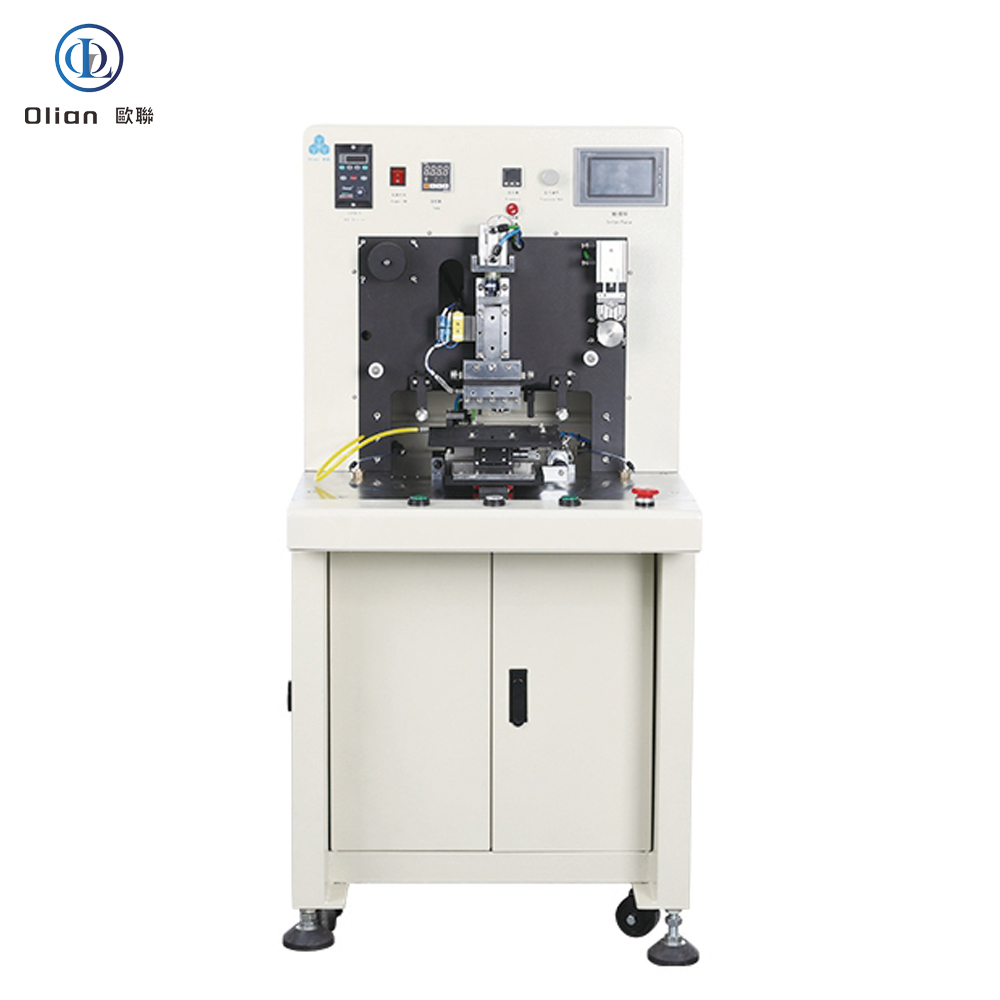
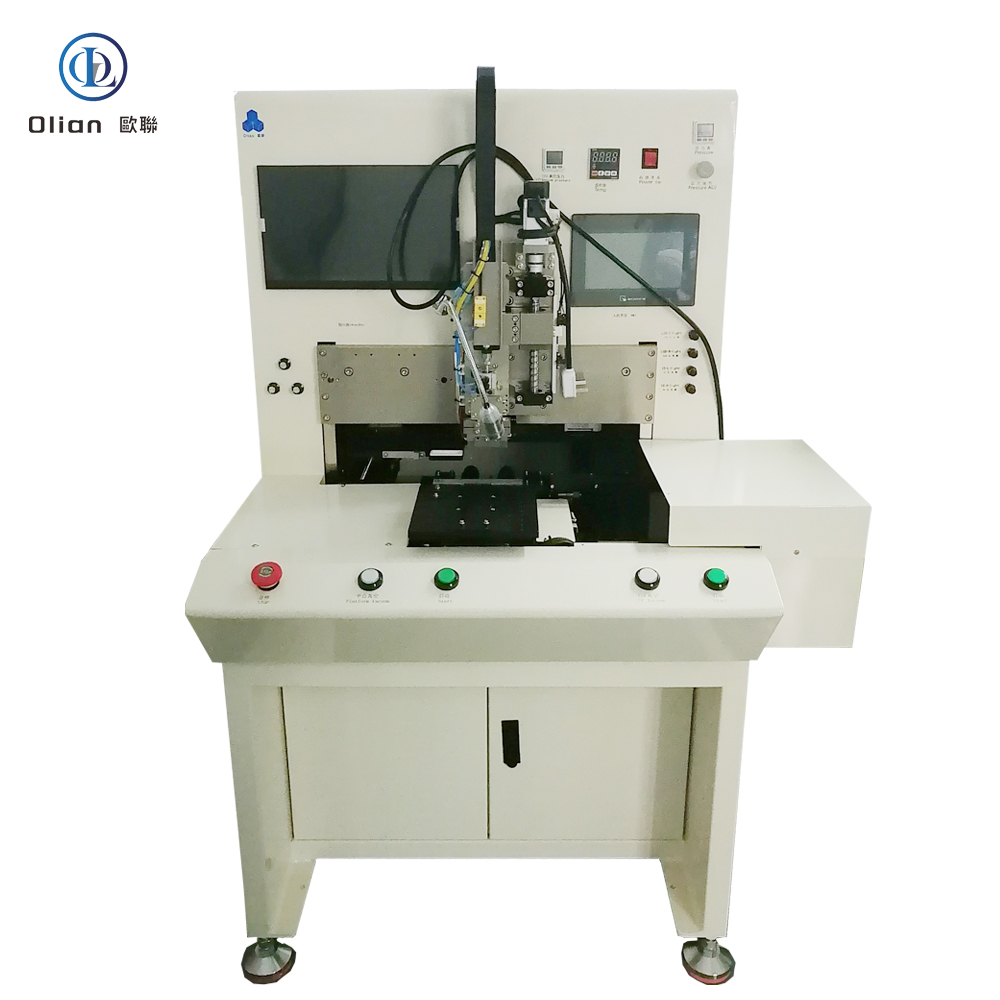
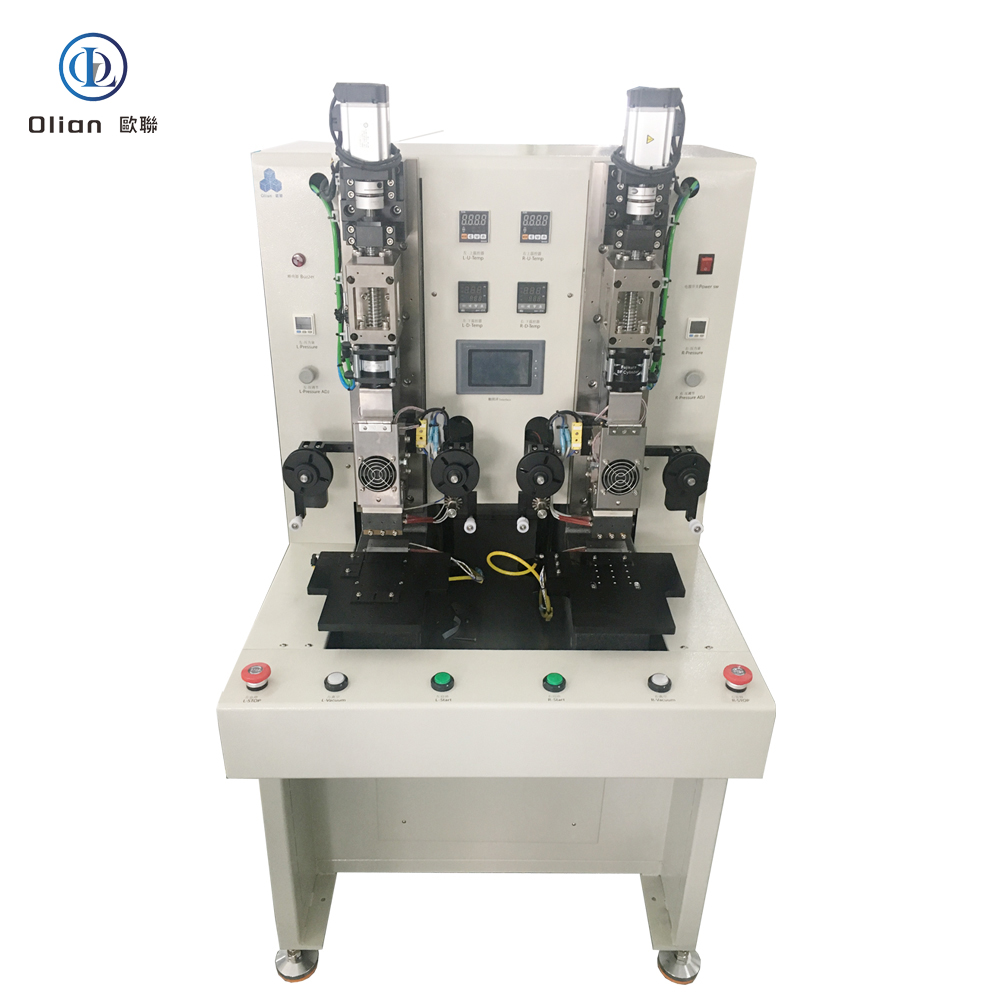
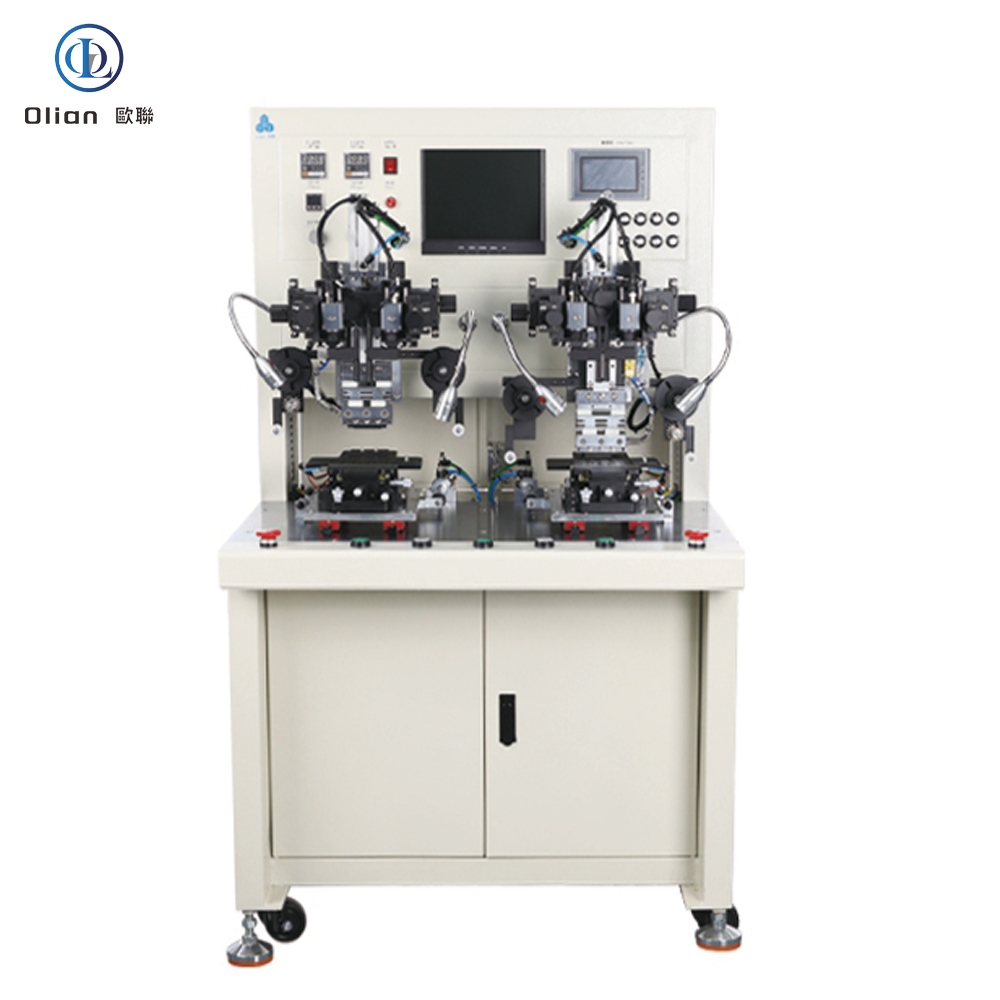
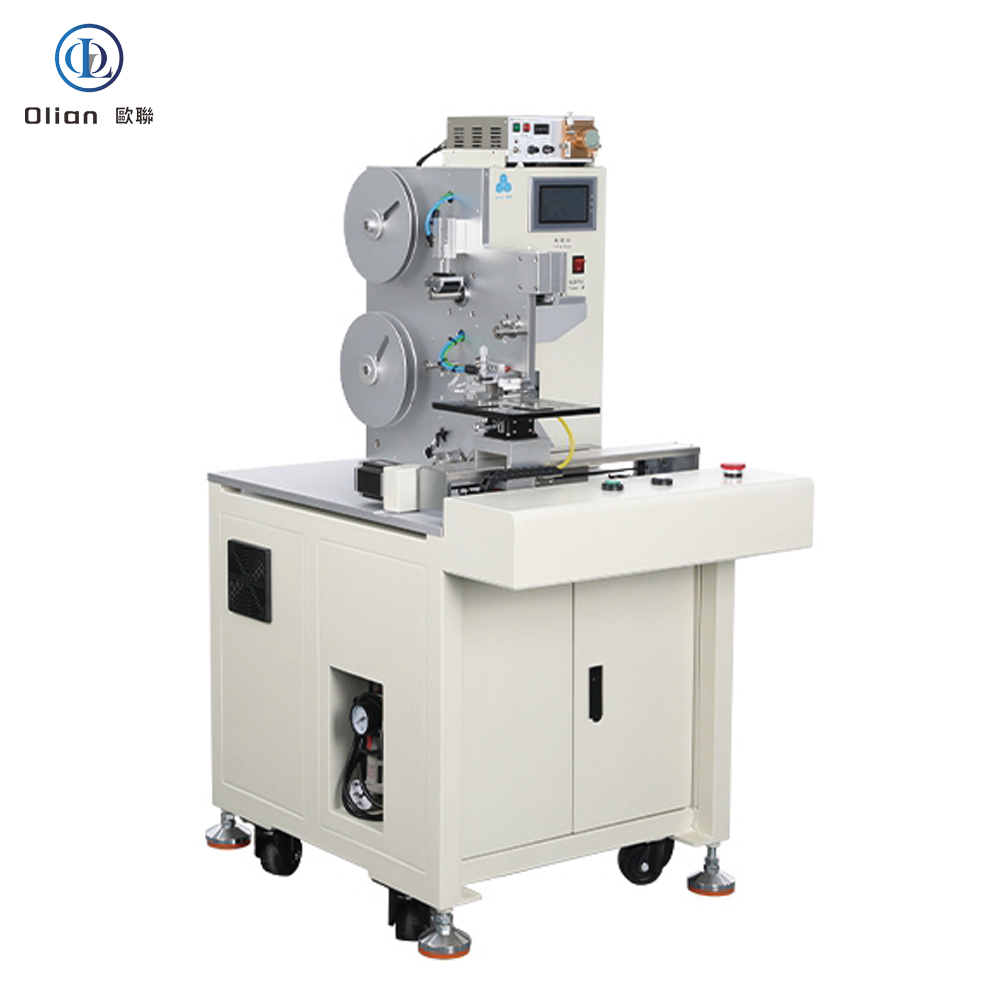
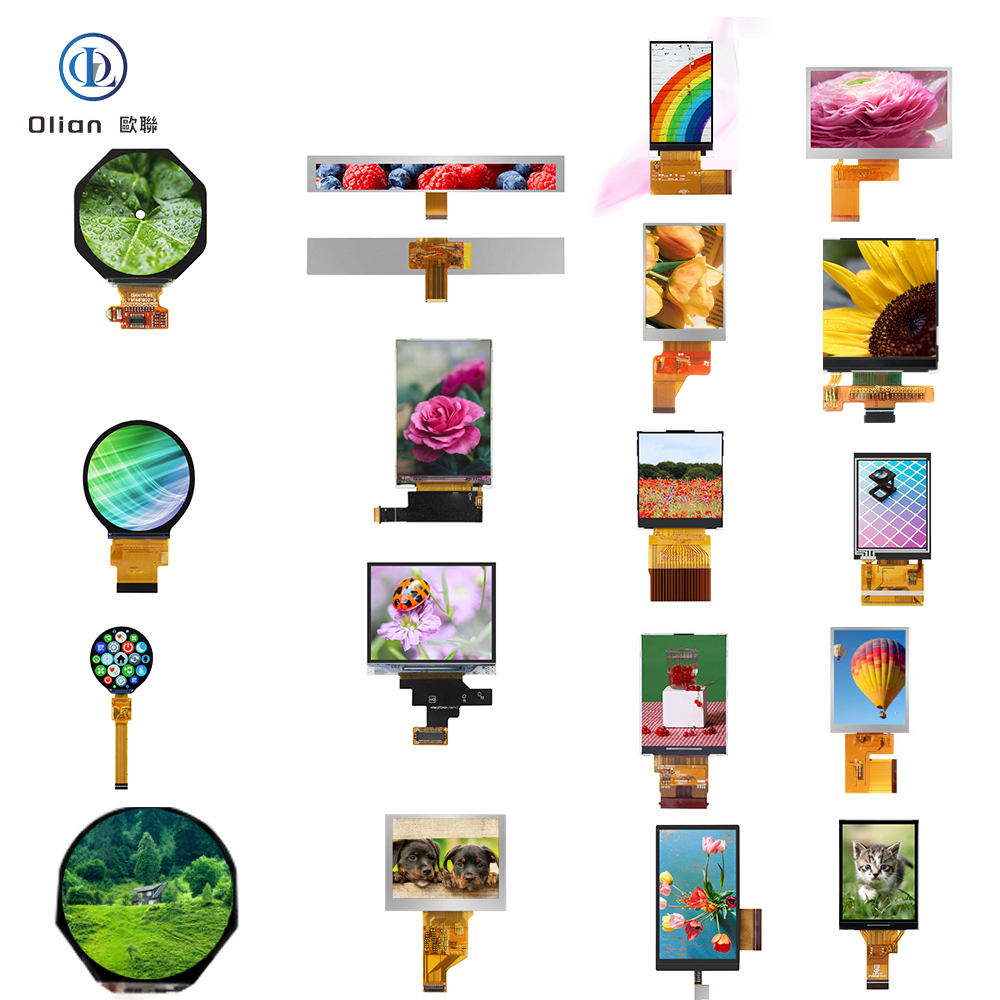
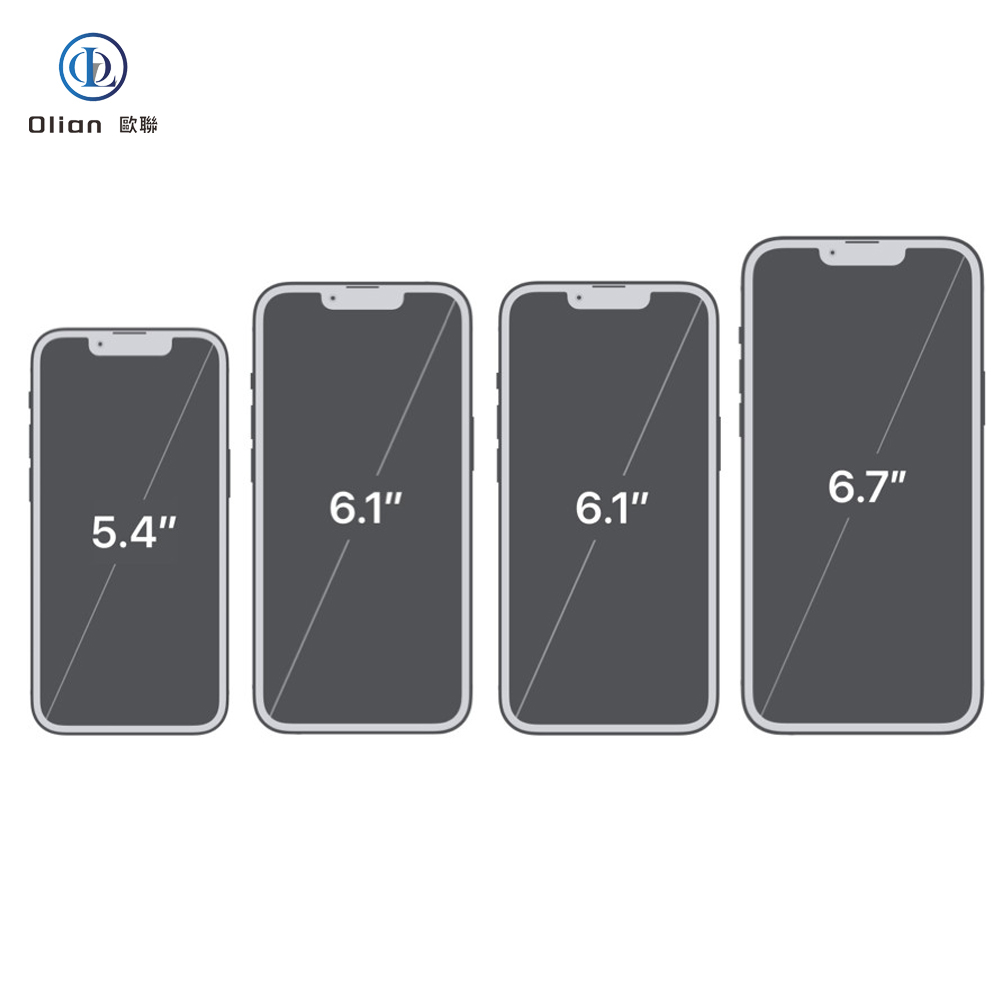
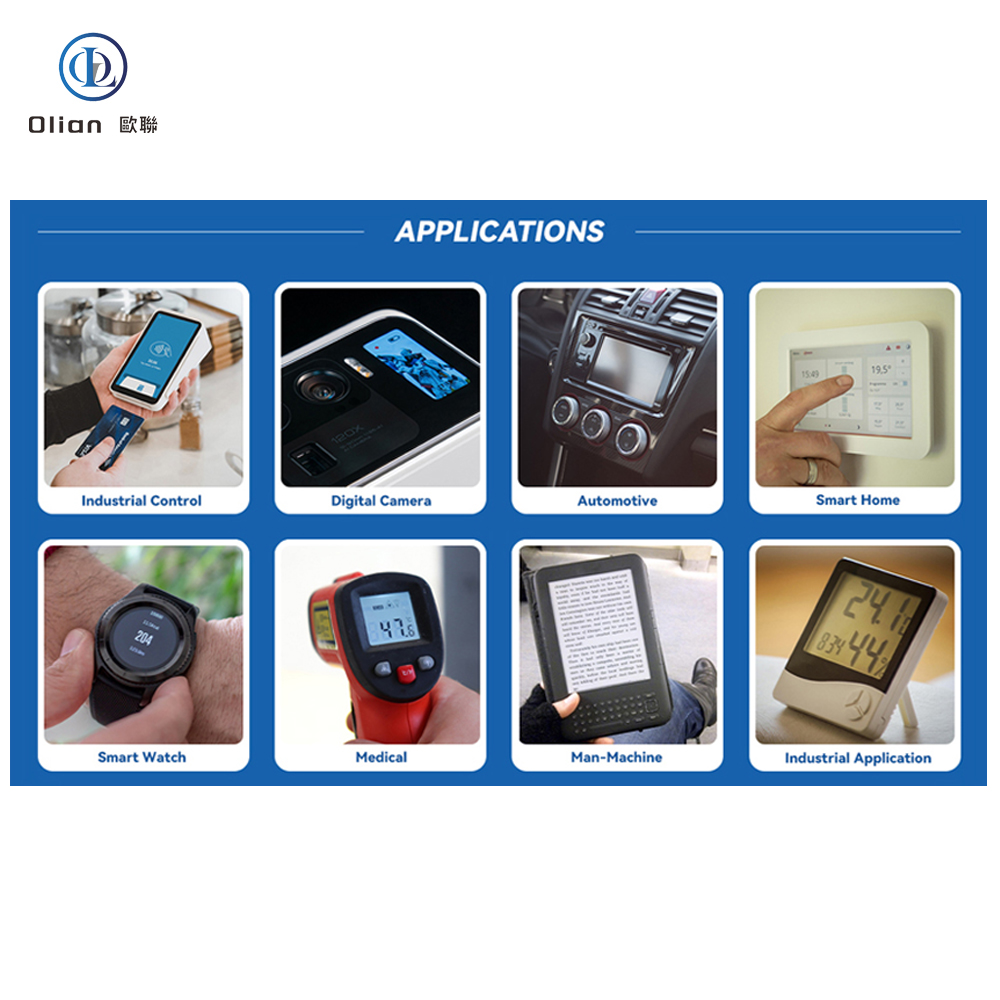
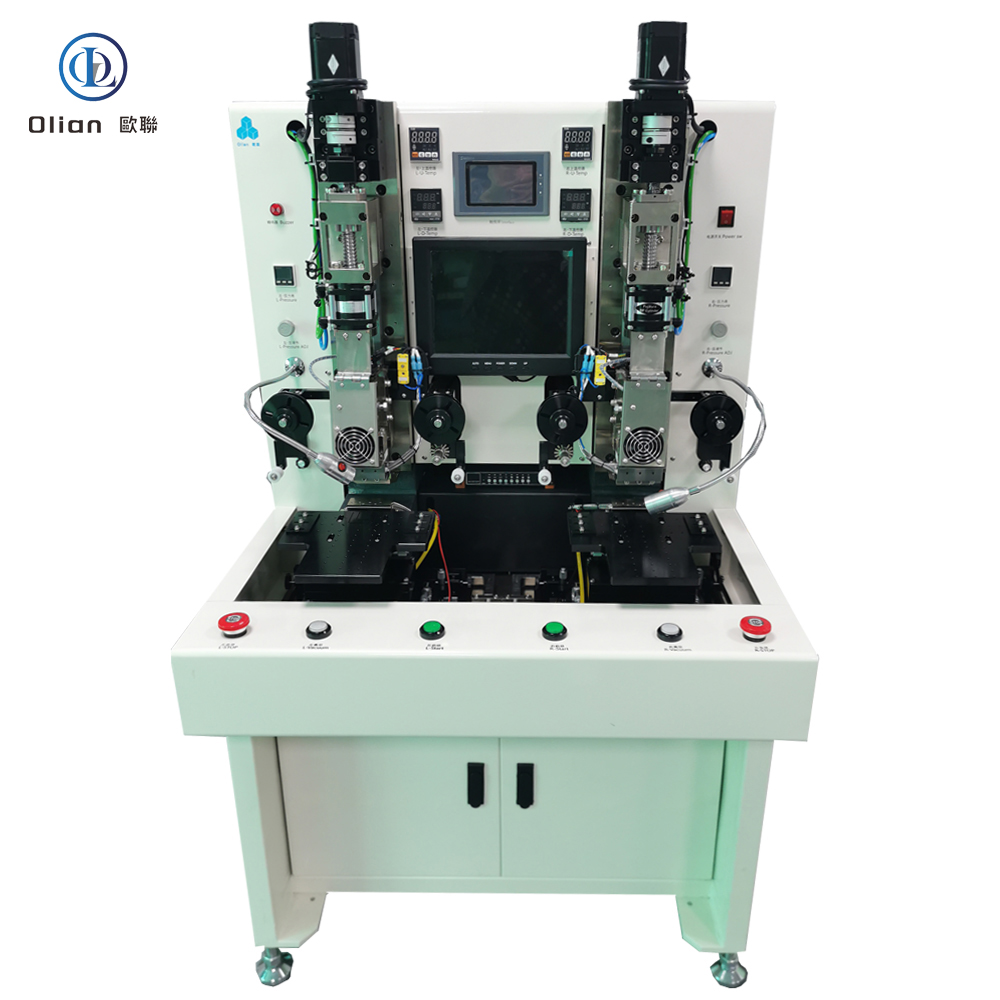
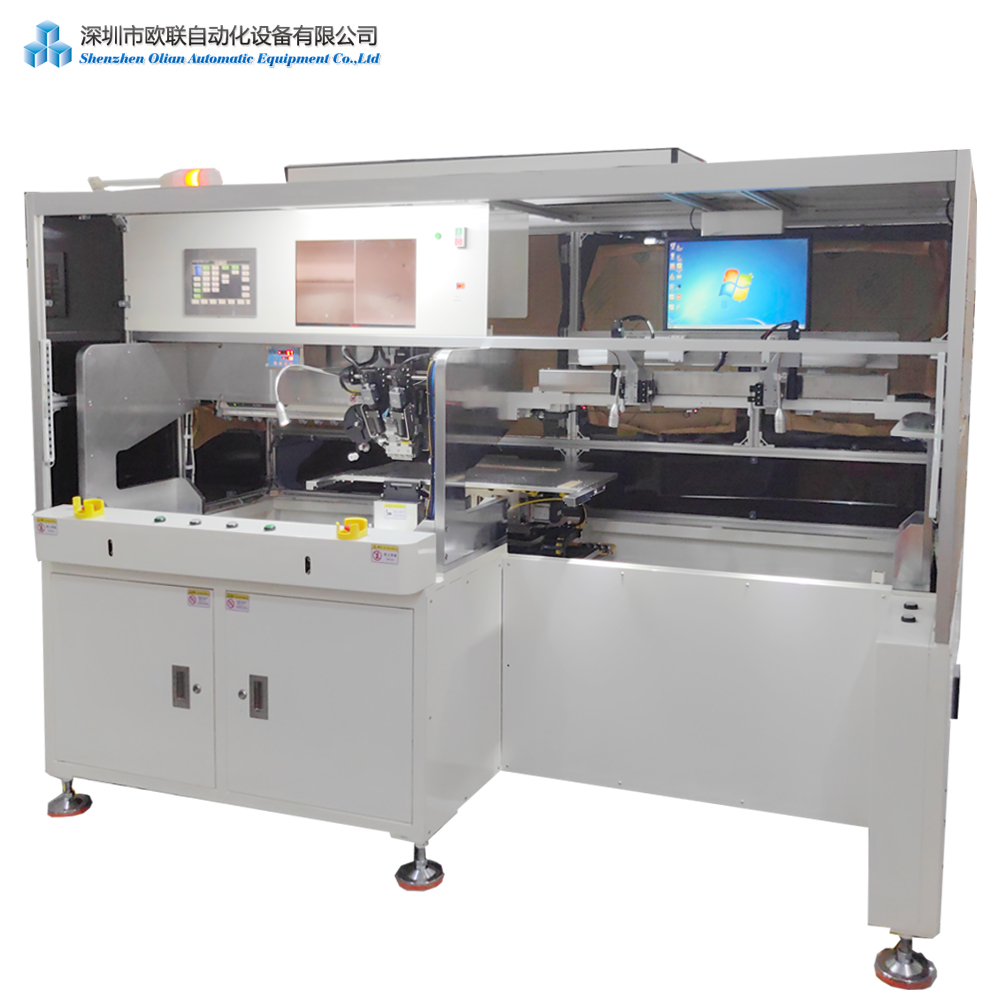
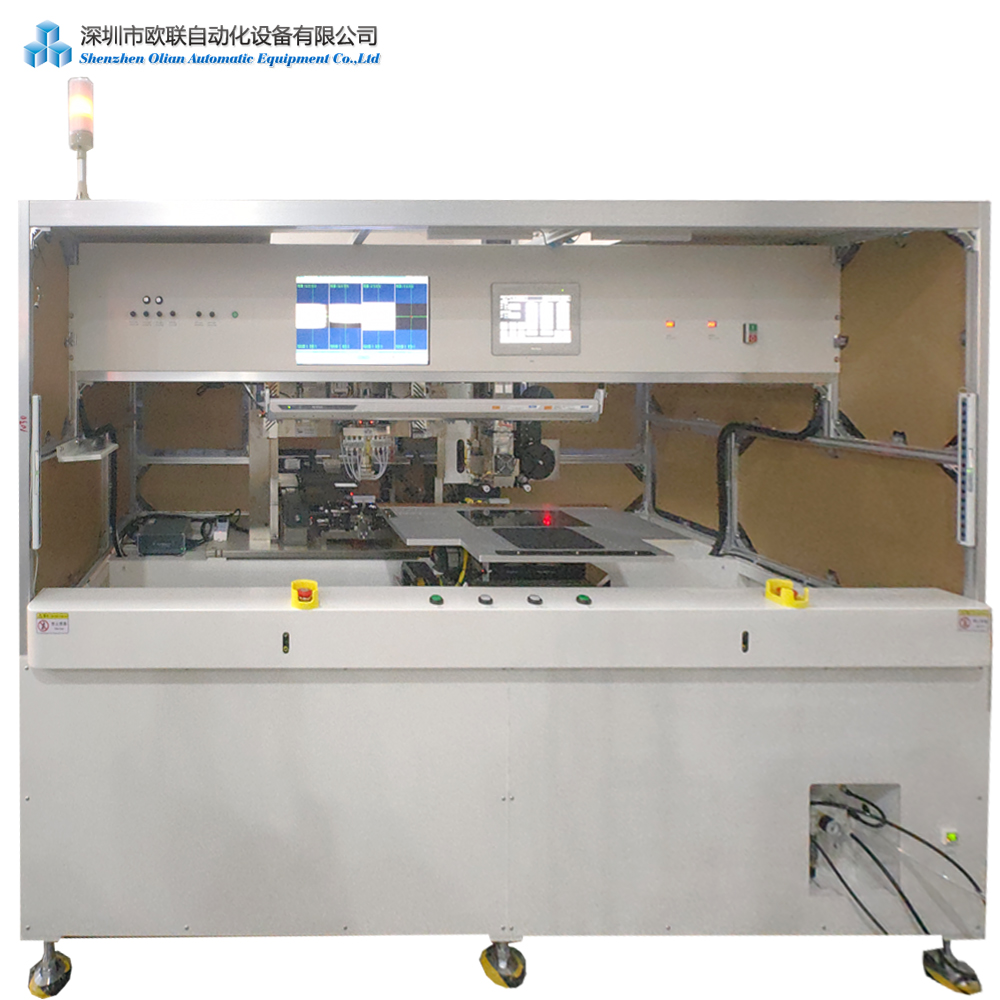
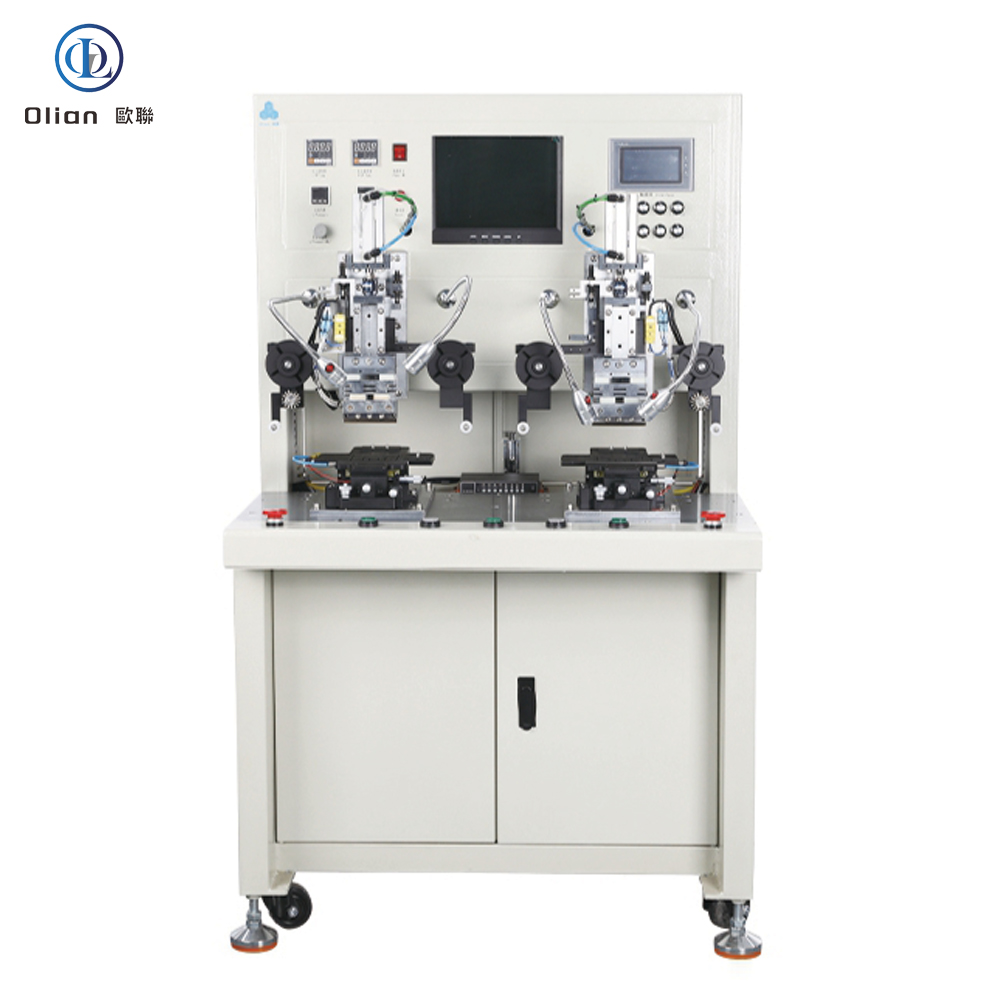
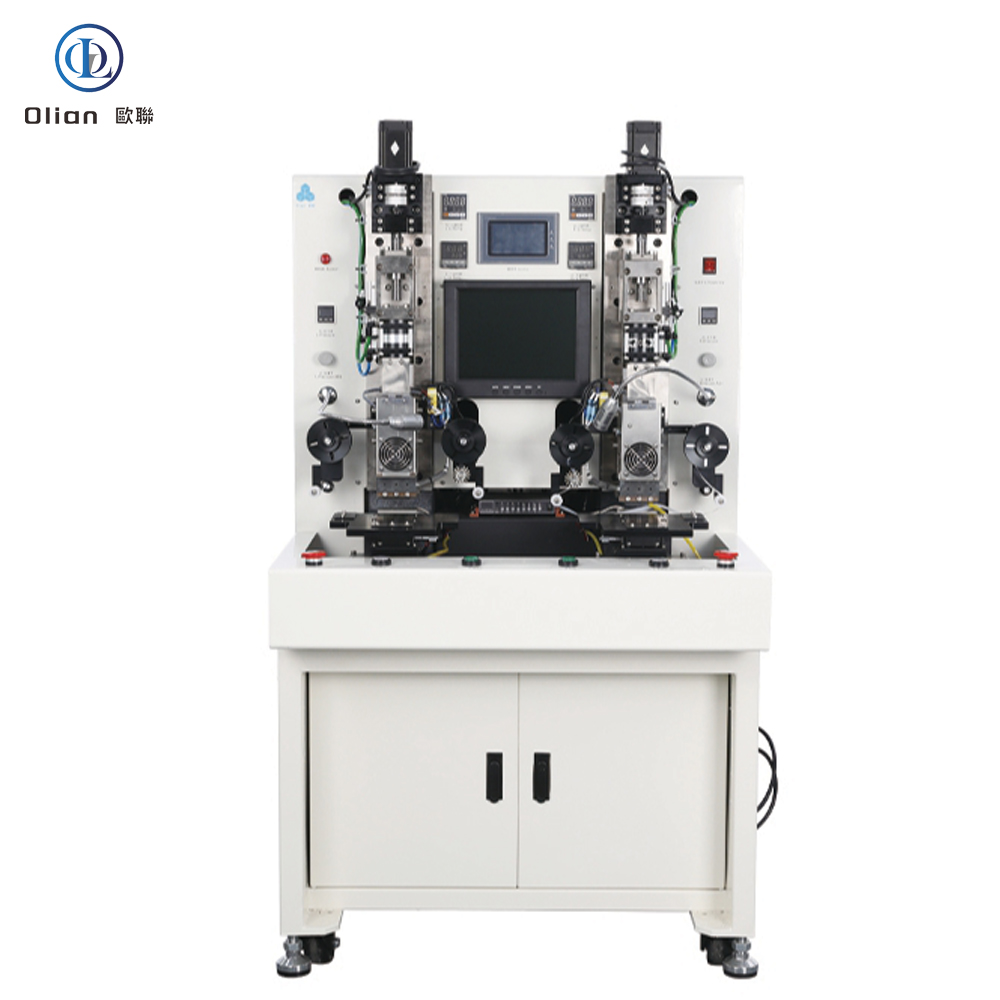
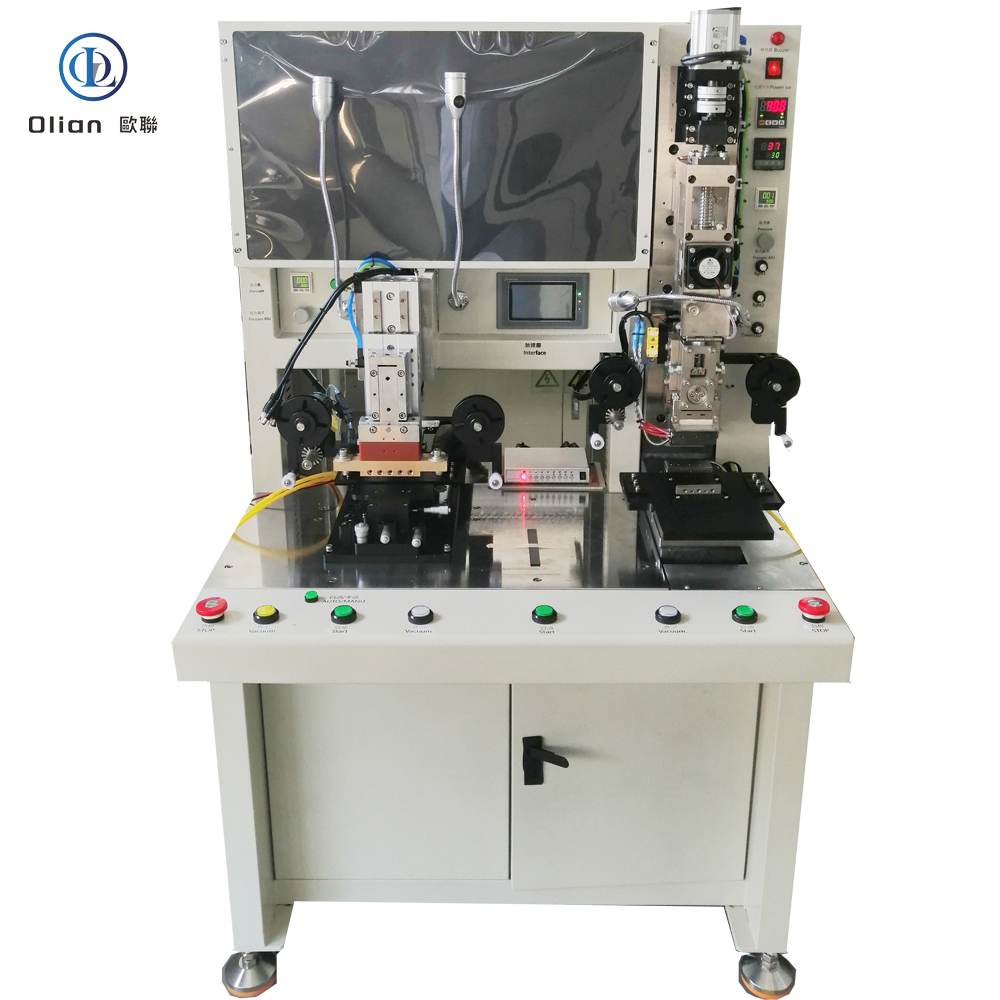
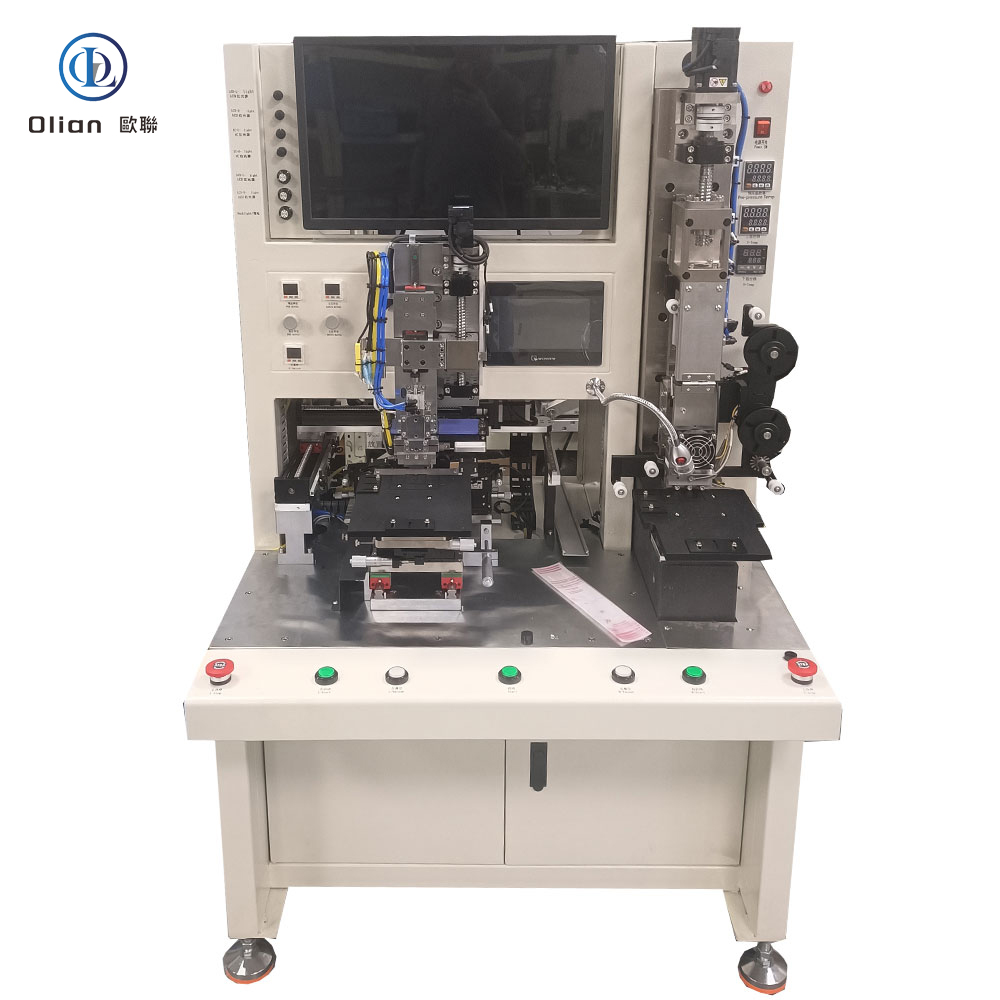
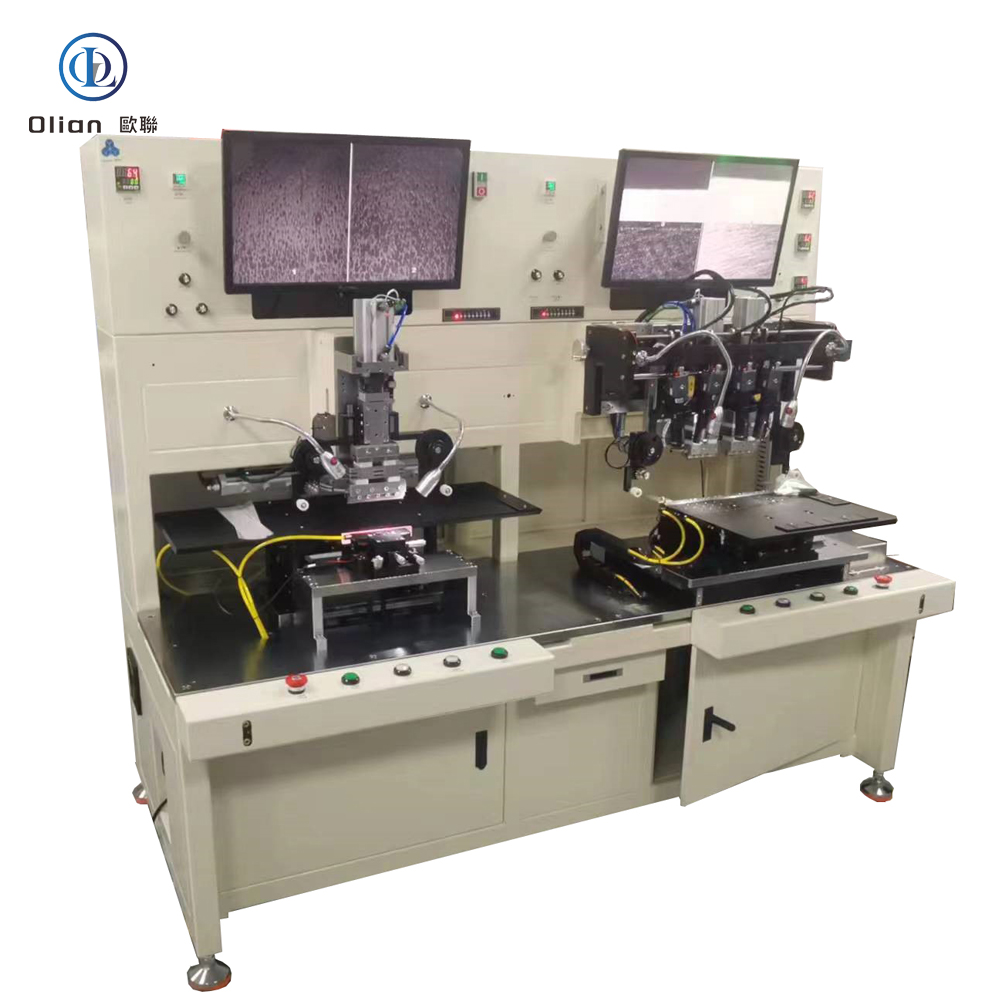
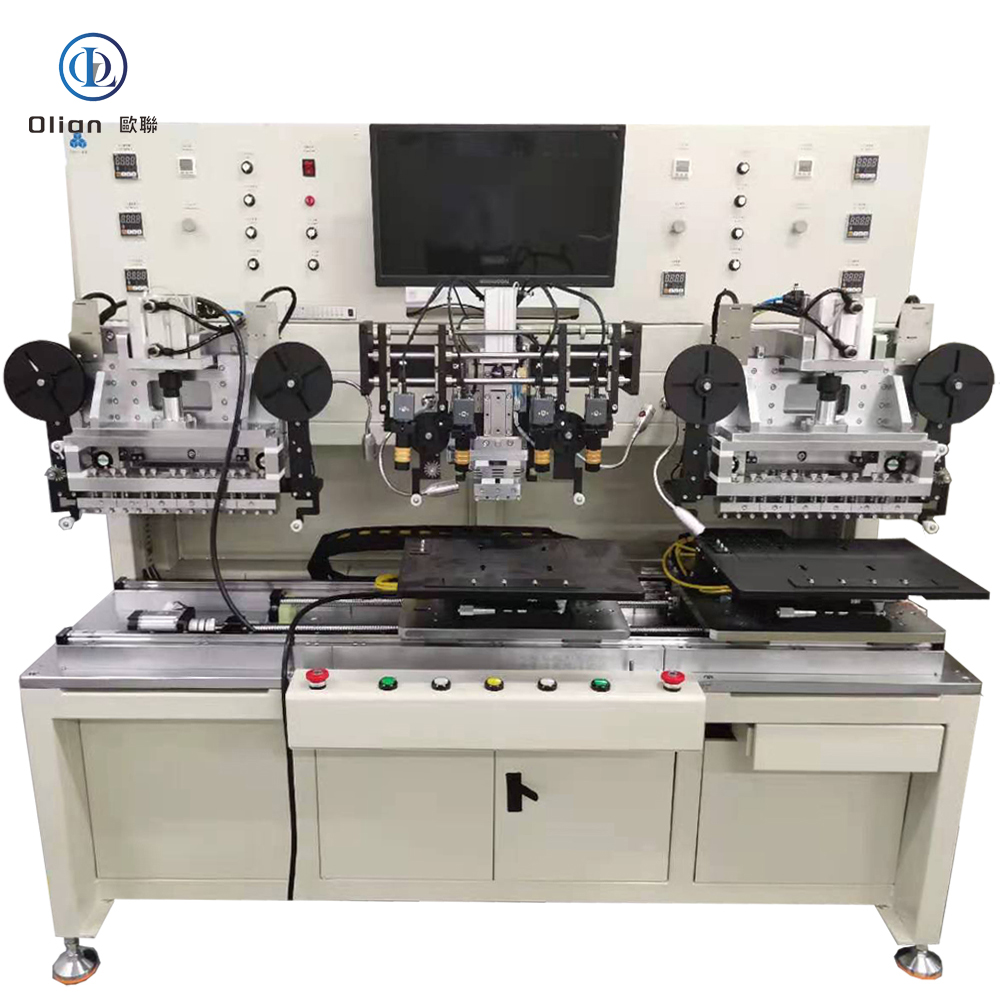
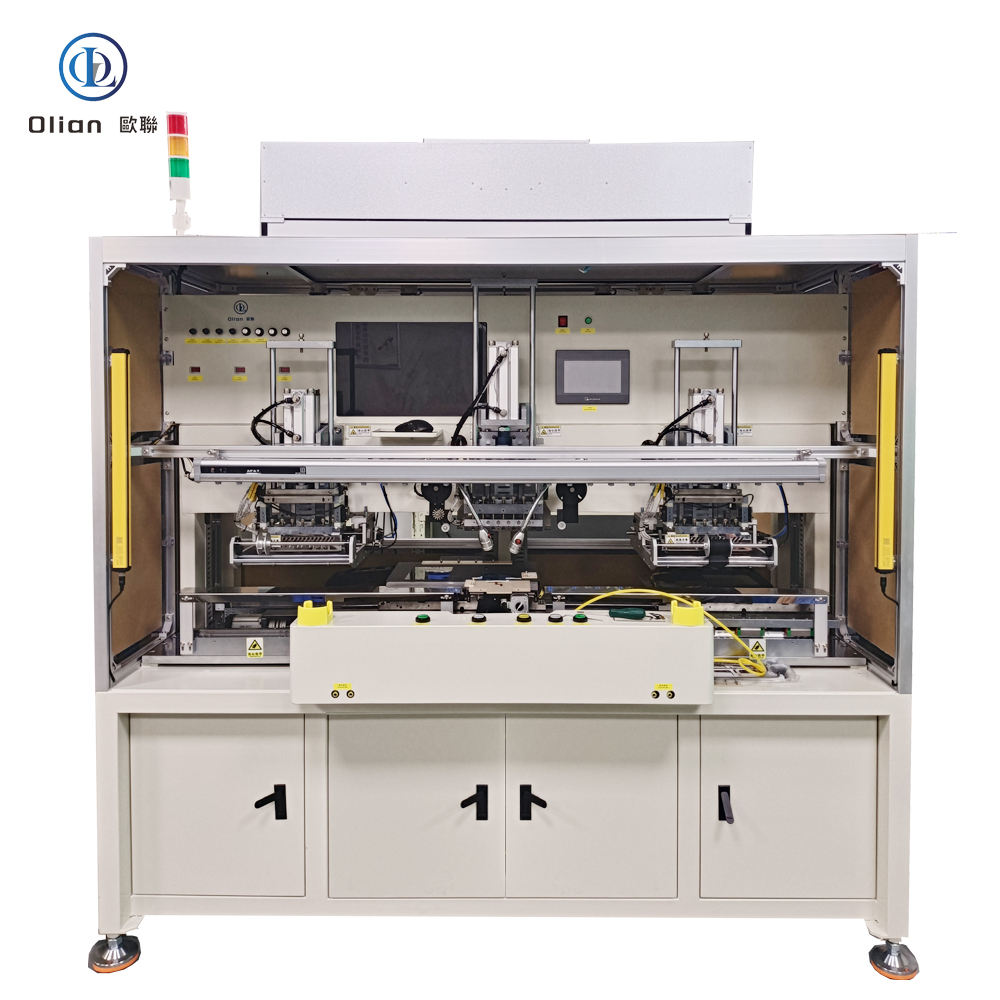
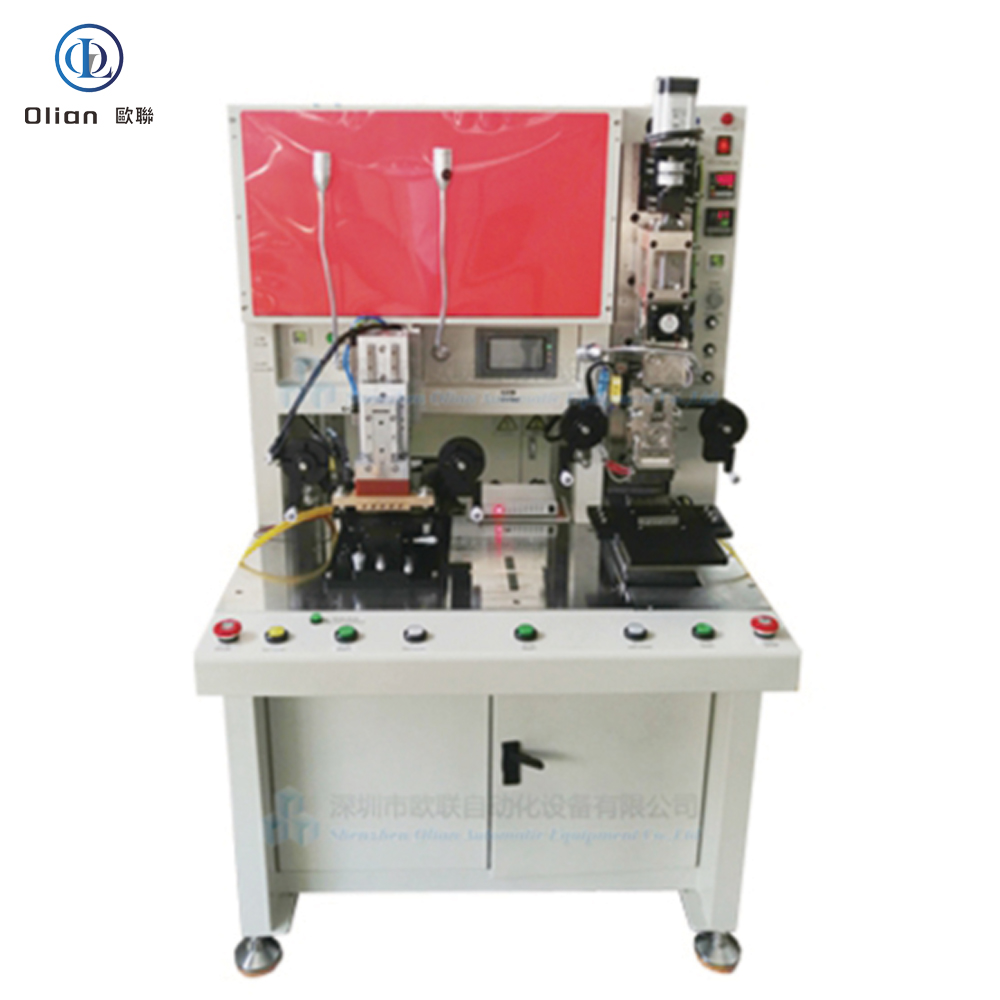
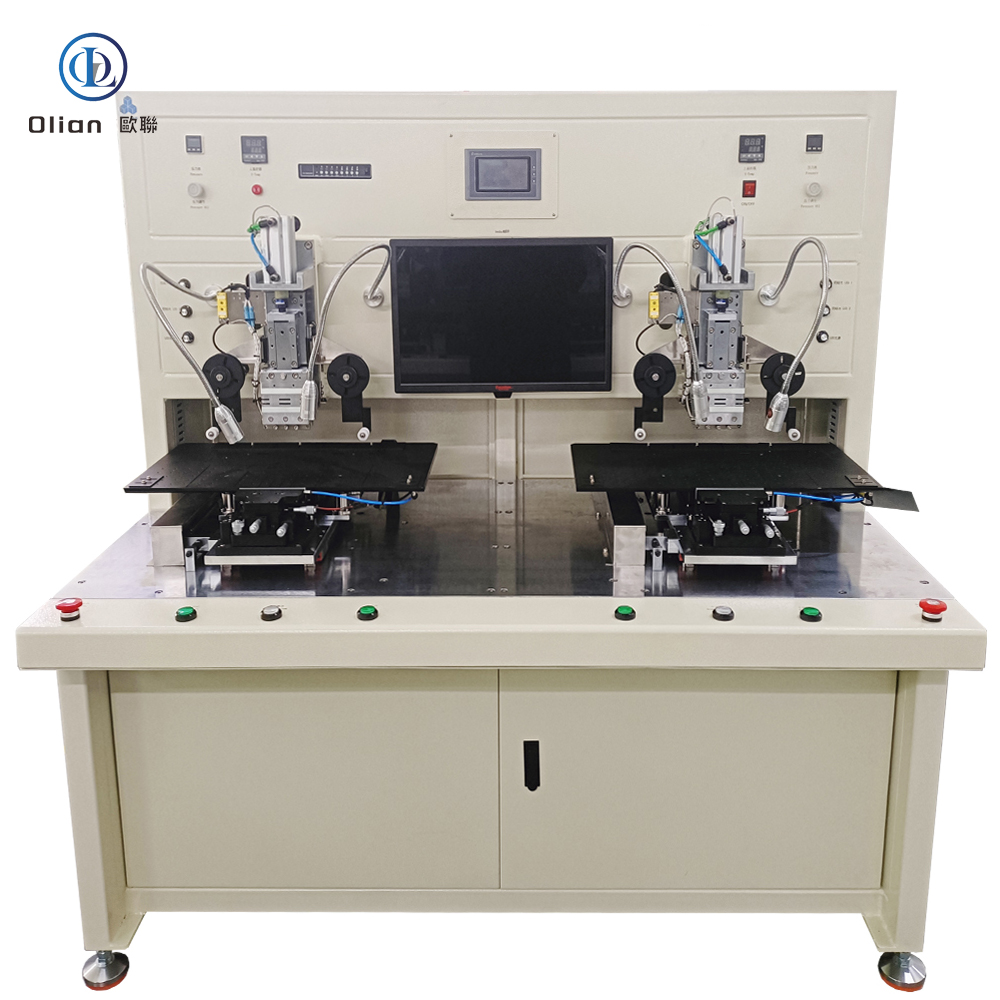
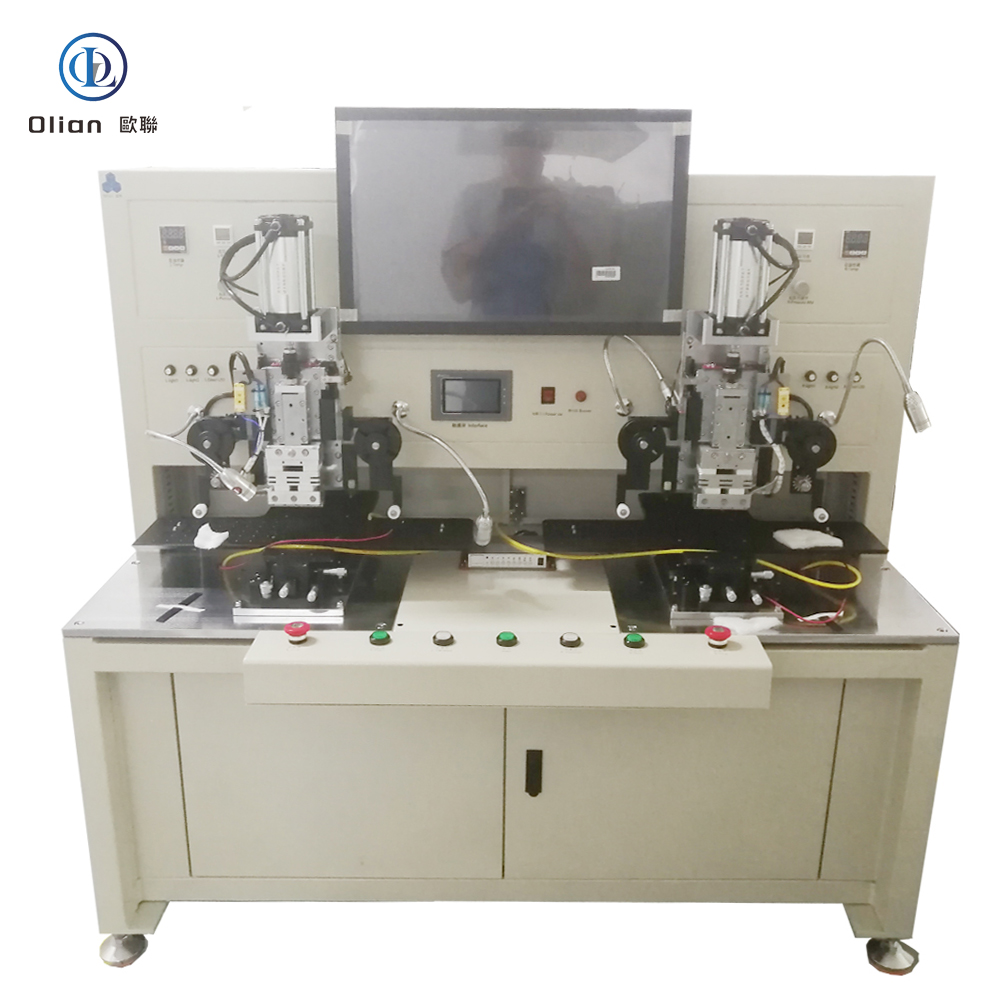
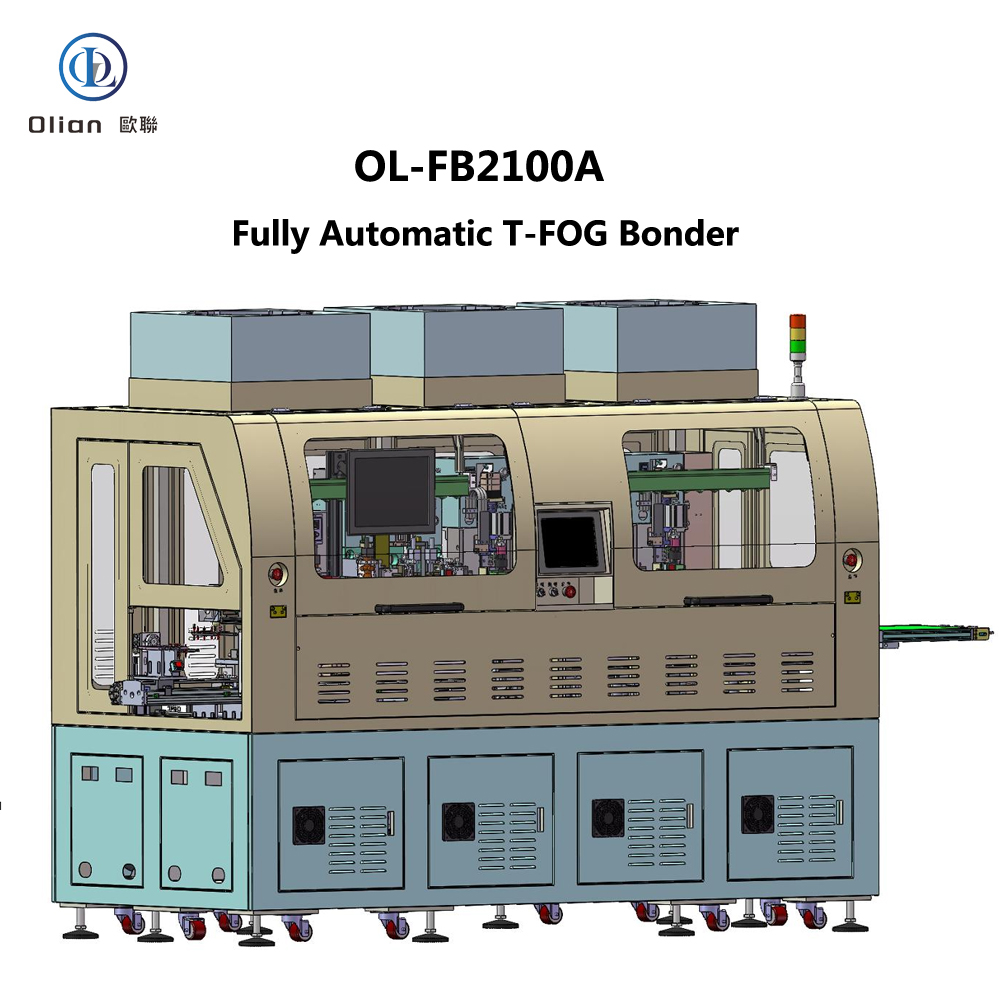
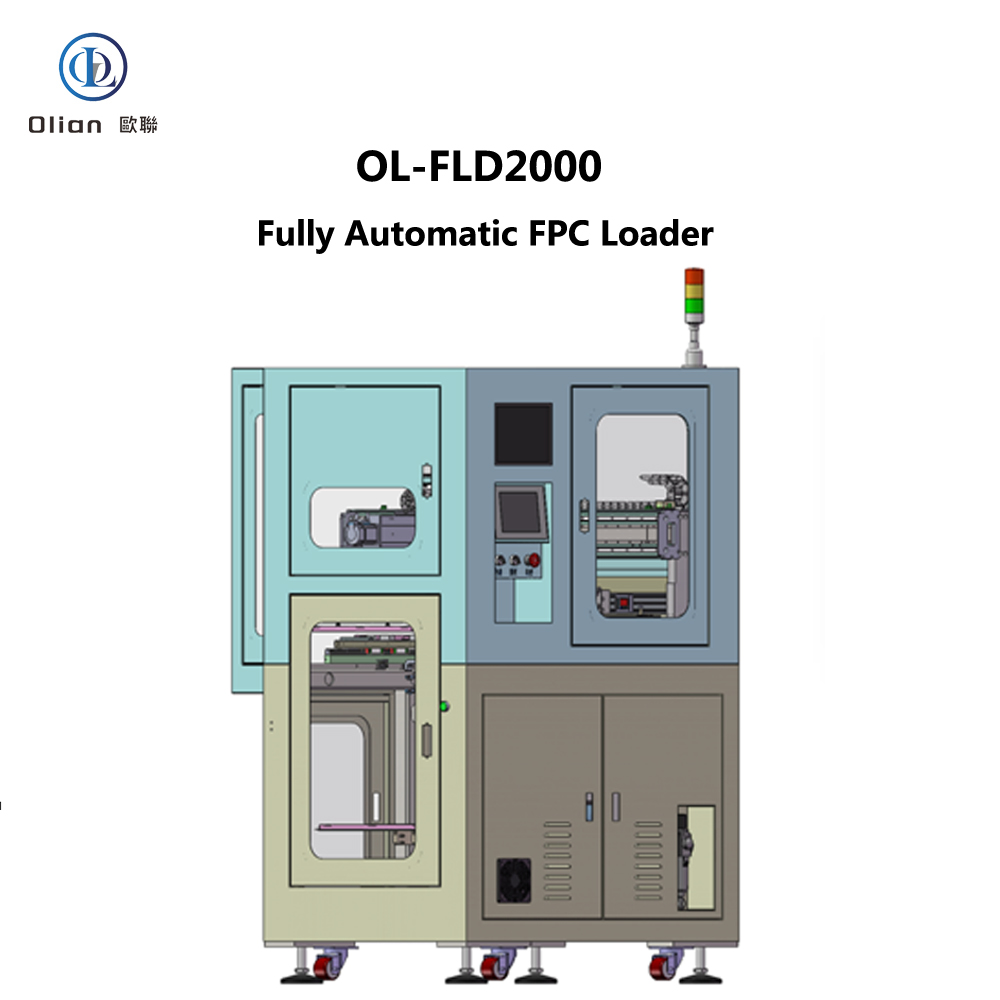
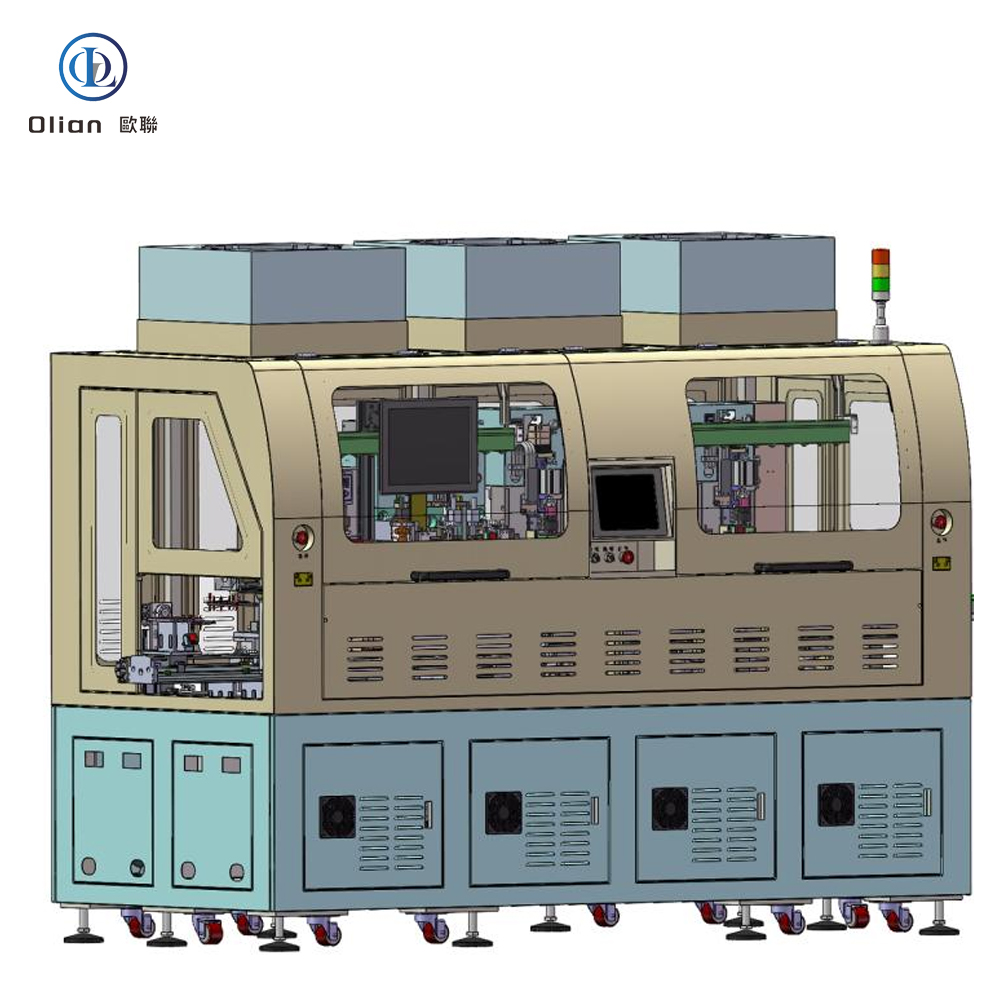
The OL-FB2100A is a cutting-edge fully automatic T-FOG (Tape Film on Glass) bonder designed to meet the precise requirements of modern electronics manufacturing. This advanced machine specializes in automatic ACF (Anisotropic Conductive Film) application, alignment, and thermal bonding for LCD products ranging from 1″ to 7″ in size, with single-sided, single FPC (Flexible Printed Circuit) components. Its innovative design and high-precision features make it an essential tool for manufacturers seeking efficiency, accuracy, and reliability in their production lines.
OL-FB2100A Fully Automatic T-FOG Bonder
Equipment Information
Equipment Name: Fully Automatic T-FOG Bonder
Model: OL-FB2100A
Application: Suitable for LCD products with sizes from 1″ to 7″, designed for automatic ACF application, alignment, and thermal bonding of single-sided, single FPC.
Compatibility: Can be integrated with other machines in a production line for seamless operation.
Working Principle
The OL-FB2100A operates through a series of coordinated mechanical and automated processes. The workflow begins with the loading of the product onto the conveyor belt or platform, either manually or via an automated upstream machine. Mechanical arm 0# picks up the LCD + COF, corrects its position using the CCD (Charge-Coupled Device) system, and places it on the ACF platform. The ACF platform advances, and the bonding head descends to apply the ACF. After the ACF application, the platform retracts for position detection to ensure proper ACF adhesion.
Next, mechanical arm 1# transfers the LCD + COF to the pre-bonding stage while the FPC is simultaneously loaded and pre-aligned on the carrier stage. The bonding head then picks up the FPC and performs the pre-bonding process. Mechanical arm 2# moves the product to one of the four main bonding platforms for final bonding. Finally, mechanical arm 3# transfers the bonded product to the downstream conveyor or production line.
Product Specifications
LCD Specifications
Size Range: Minimum 20mm x 20mm, Maximum 230mm x 120mm, Thickness 0.15mm to 1.1mm.
Alignment Marks: Pitch ≥ 5mm between any two points on the glass, Mark size 2mm to 100mm.
FPC Specifications
Size Range: Minimum 20mm x 10mm, Maximum 150mm x 122mm, Thickness 0.1mm to 0.5mm.
Terminal Pitch: ≥ 50µm.
Alignment Marks: Pitch 5mm to 70mm.
Note: FPC width is related to the bonding head length and can be customized according to customer requirements.
ACF Specifications
Types: Roll-based, 2-layer or 3-layer.
Application Length: 5mm to 80mm.
Application Width: Available in 0.8mm, 1.0mm, 1.5mm, 2.0mm, and 2.5mm widths, adjustable according to requirements.
Reel Specifications: Inner diameter options of 18mm and 25mm, Maximum reel diameter 200mm.
Width Adjustment: Manual width adjustment with limit wheel.
Sensor detection for tape end monitoring.
Image Processing Unit
LCD Correction:
System: Bos视 image processing system.
CCD Camera: 1.
Coaxial Light Barrel: 1.
Magnification: 1x.
Field of View: 4.8mm × 3.6mm.
Light Source: Coaxial light LED.
Z-axis Adjustable Travel: 10mm.
ACF Inspection:
System: Bos视 detection system.
CCD: 1.
Coaxial Light Barrel: 1.
Magnification: 0.5x.
Field of View: 9.6mm × 7.2mm.
Light Source: Coaxial light LED.
Pre-bonding Alignment:
System: Bos视 image processing system.
CCD Cameras: 2 & 4.
Coaxial Light Barrels: 2 & 4.
Magnification: 2x.
Field of View: 2.4mm × 1.8mm.
Light Source: Coaxial light LED.
Alignment Method: Mark coincidence & four-phase correlation alignment.
Main Bonding Alignment:
System: Bos视 image processing system.
CCD Camera: 1.
Coaxial Light Barrel: 1.
Magnification: 1x.
Field of View: 4.8mm × 3.6mm.
Light Source: Coaxial light LED.
Z-axis Adjustable Travel: 10mm.
Control Unit
Control Method: PLC control.
Touchscreen:
Interface: Chinese, touch-enabled.
Modes: Manual and automatic.
Functions: Parameter display, data storage for 100 varieties.
Manual Control Buttons:
Emergency Stop Buttons: 3.
Main Power Switch: 1.
Lighting Power Switch: 1.
Access Control: Machine pauses when doors are opened during operation.
Operation Indicator Lights: Tri-color lights.
Documentation and After-sales Service
Documentation: Machine operation manual included.
Training: Covers installation, operation, calibration, maintenance, troubleshooting, and safety precautions.
After-sales Service: One year of free service for non-human-induced faults, with lifelong technical support.
Main Component Brands
Servo Motors: Fuji (except for robot arm Z-axis) / Rite (robot arm Z-axis) (Japan/China).
Ball Screws: Hiwin/THK (China/Japan).
DDR: NSK (Japan).
Guideways: Hiwin/THK (China/Japan).
Pneumatic Components: SMC/Airtac (Japan/China).
PLC: Keyence (Japan).
Touchscreen: Proface (Japan).
Sensors: Panasonic/Huan (Japan/China).
Power Supply: Mean Well (Taiwan).
Circuit Breakers and Contactors: Schneider/Shihlin (Taiwan).
Drag Chains: Igus (Germany).
In summary, the OL-FB2100A Fully Automatic T-FOG Bonder represents a significant advancement in the field of LCD manufacturing equipment. Its precise engineering, user-friendly design, and comprehensive support make it an ideal choice for manufacturers seeking to enhance productivity and product quality in the competitive electronics market.
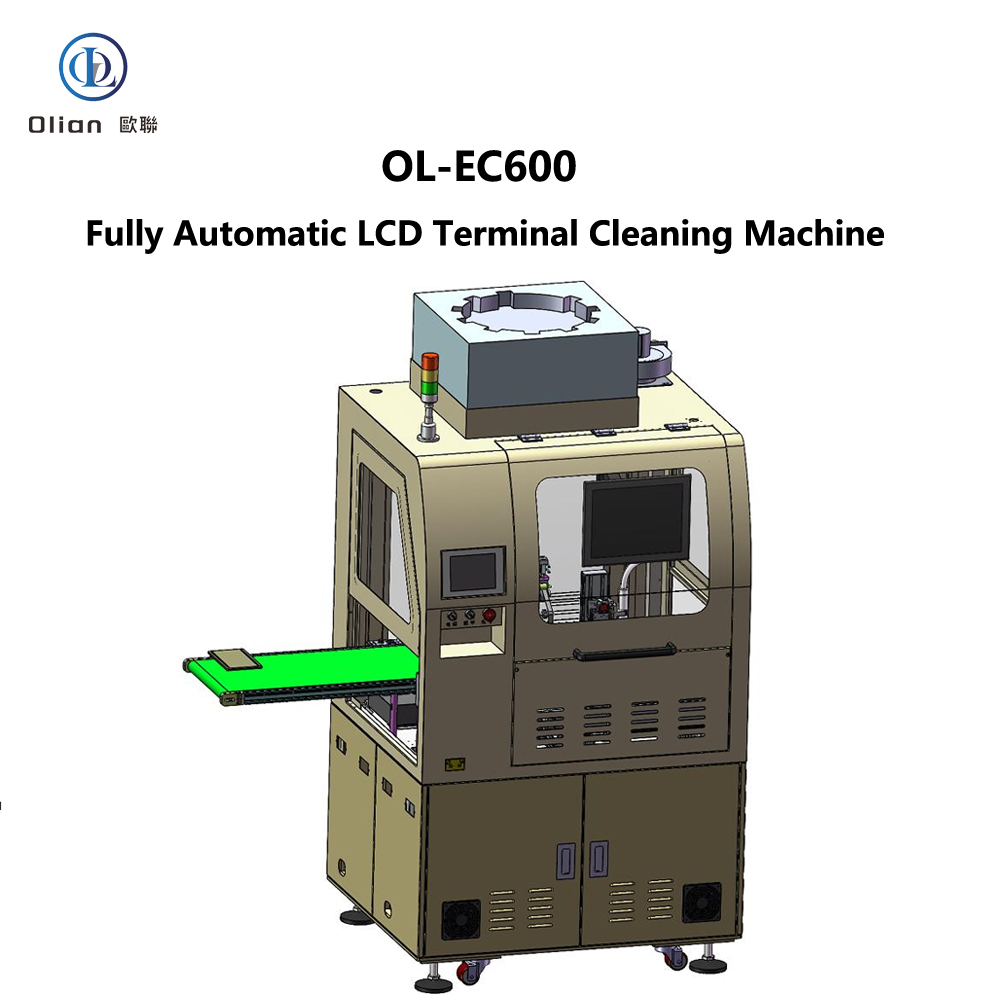
The EC-600 is a highly efficient fully automatic LCD terminal cleaning machine designed to perform wiping, cleaning, and plasma treatment for LCD products of various sizes (from 20mm x 20mm to 150mm x 90mm). This advanced machine can be integrated with other devices in a production line, making it a valuable addition to modern manufacturing environments where precision and speed are critical.
Function: Cleans LCD products through wiping, cleaning, and plasma treatment.
Compatibility: Can be connected with other equipment for automated production lines.
Working Principle
The EC-600 operates through a series of automated processes. It starts with manual placement of the LCD onto a platform or conveyor belt. Robotic arm 1# picks up the LCD, corrects its position using the CCD (Charge-Coupled Device) system, and places it on the wiping platform. The platform then moves the LCD to the cleaning head for cleaning. After wiping, robotic arm 2# transports the LCD to a plasma cleaning platform for further cleaning. Finally, the cleaned LCD is moved to a discharge station.
Product Specifications
LCD Specifications
Size Range: Minimum 20mm x 20mm, Maximum 150mm x 90mm, Thickness 0.15mm to 1.1mm.
Cleaning Cloth Specifications
Type: Roll-based (number of rolls: 2).
Width: ≤ 10mm.
Maximum Roll Diameter: ≤ 300mm.
Roll Inner Hole Diameter: ≥ 24.5mm.
Feed Length: Adjustable from 0.1mm to 99.9mm.
Cleaning Solvent
Type: Alcohol or acetone.
Machine Performance
Production Cycle
Cycle Time: 3.5 seconds per piece for screens up to 4 inches, and 4.2 seconds per piece for screens between 4 and 6.5 inches.
Handling Precision
Precision: ±0.1mm.
Water Drop Angle
Water Drop Angle: ≤ 15 degrees, depending on actual conditions.
Product Type
Supported Type: Single-edge terminal face cleaning.
Model Changeover
New Model Setup: ≤ 30 minutes.
Existing Model Recall: ≤ 15 minutes, depending on the operator’s proficiency.
Linear Motors: Yakobes/Linea/Dongxin (China/China/China).
Ball Screws: THK/Hiwin/TBI (Japan/China/China).
Guideways: THK/Hiwin/TBI (Japan/China/China).
Pneumatic Components: SMC/Airtac (Japan/China).
PLC: Panasonic (Japan).
Touchscreen: Proface/Weilin (Japan/China).
Sensors: Panasonic/Huan (Japan/China).
Power Supply: Mean Well (China).
Circuit Breakers and Contactors: Schneider/Shihlin/Chint (China).
Drag Chains: Igus (Germany).
In summary, the EC-600 Fully Automatic LCD Terminal Cleaning Machine represents a significant advancement in LCD manufacturing equipment. Its precise engineering, user-friendly design, and comprehensive support make it an ideal choice for manufacturers seeking to enhance productivity and product quality in the competitive electronics market.
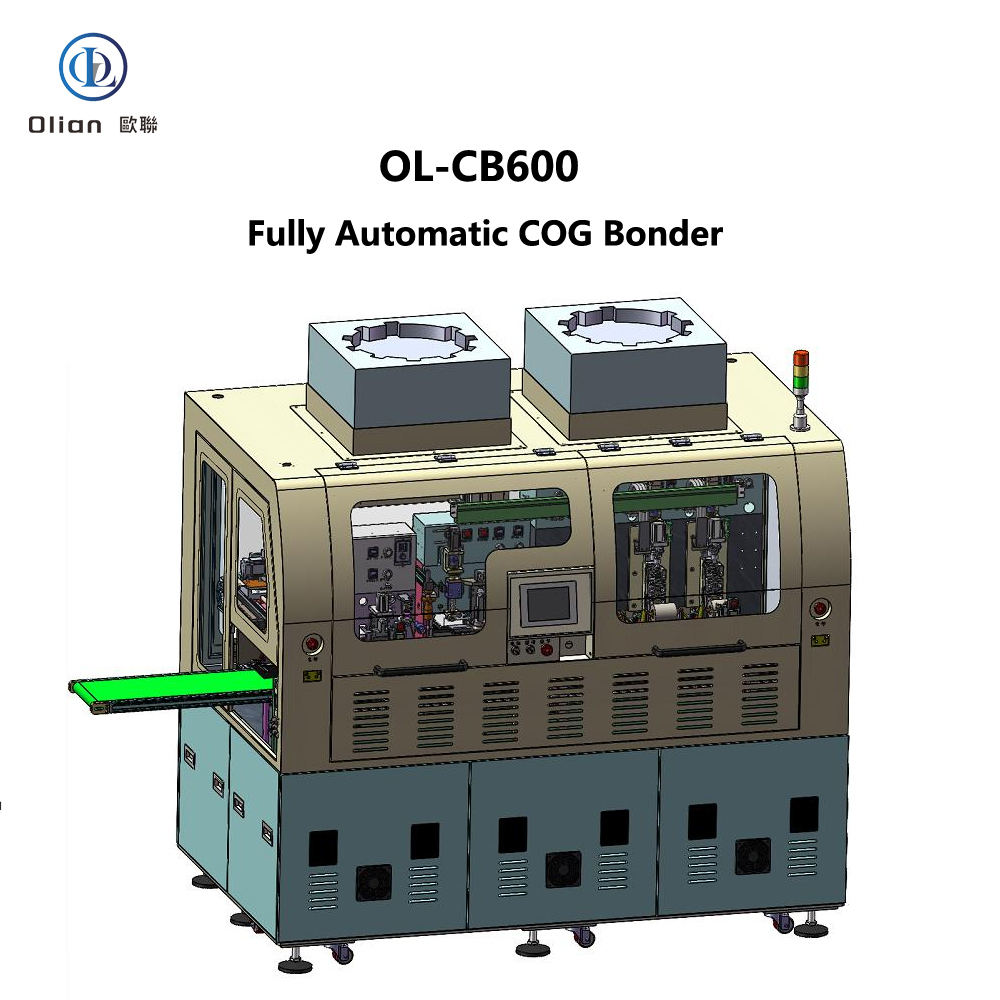
The CB-600 is a cutting-edge fully automatic COG (Chip on Glass) bonder designed to meet the precise requirements of modern electronics manufacturing. This advanced machine specializes in automatic ACF (Anisotropic Conductive Film) application, pre-bonding, and main bonding processes for LCD products ranging from 1″ to 6.5″ in size, with single-sided, single IC components. Its innovative design and high-precision features make it an essential tool for manufacturers seeking efficiency, accuracy, and reliability in their production lines.
CB-600 Fully Automatic COG Bonder
Equipment Information
Equipment Name: Fully Automatic COG Bonder
Model: CB-600
Application: Suitable for LCD products with sizes from 1″ to 6.5″, designed for automatic ACF application, pre-bonding, and main bonding of single-sided, single IC.
Compatibility: Can be integrated with other machines in a production line for seamless operation.
Working Principle
The CB-600 operates through a series of coordinated mechanical and automated processes. The workflow begins with the loading of the product onto the conveyor belt or platform, either manually or via an automated upstream machine. Mechanical arm 1# picks up the product, corrects its position using the CCD (Charge-Coupled Device) system, and places it on the ACF platform. The ACF platform advances, and the bonding head descends to apply the ACF. After the ACF application, the platform retracts for position detection to ensure proper ACF adhesion. Mechanical arm 3# then picks up the LCD, checks the ACF adhesion, and places it on the pre-bonding stage. Meanwhile, the IC is loaded, and the automatic feeding system visually corrects the IC position. After pre-alignment, the IC is moved to the bonding head position, and the bonding head picks it up for pre-bonding. Mechanical arm 4# moves the product to one of the three main bonding platforms for final bonding. Finally, mechanical arm 5# transfers the bonded product to the downstream conveyor or production line.
Product Specifications
LCD Specifications
Size Range: Minimum 20mm x 20mm, Maximum 150mm x 90mm, Thickness 0.15mm to 1.1mm.
Alignment Marks: Pitch ≥ 5mm between any two points on the glass, Mark size 200µm to 1000µm.
IC Specifications
Terminal Pitch: ≥ 30µm.
Alignment Marks: Pitch 5mm to 70mm.
ACF Specifications
Types: Roll-based, 2-layer or 3-layer.
Application Length: 5mm to 80mm (adjustable based on bonding head length and customer requirements).
Application Width: 0.5mm to 5.0mm.
Reel Specifications: Inner diameter options of 18mm and 25mm, Maximum reel diameter 200mm.
Linear Motors: Yakobes/Linea/Dongxin (China/China/China).
Ball Screws: THK/Hiwin/TBI (Japan/China/China).
Guideways: THK/Hiwin/TBI (Japan/China/China).
Pneumatic Components: SMC/Airtac (Japan/China).
PLC: Keyence (Japan).
Touchscreen: Proface (Japan).
Sensors: Panasonic/Huan (Japan/China).
Power Supply: Mean Well (China).
Circuit Breakers and Contactors: Schneider/Shihlin/Chint (China).
Drag Chains: Igus (Germany).
In summary, the CB-600 Fully Automatic COG Bonder represents a significant advancement in the field of LCD manufacturing equipment. Its precise engineering, user-friendly design, and comprehensive support make it an ideal choice for manufacturers seeking to enhance productivity and product quality in the competitive electronics market.
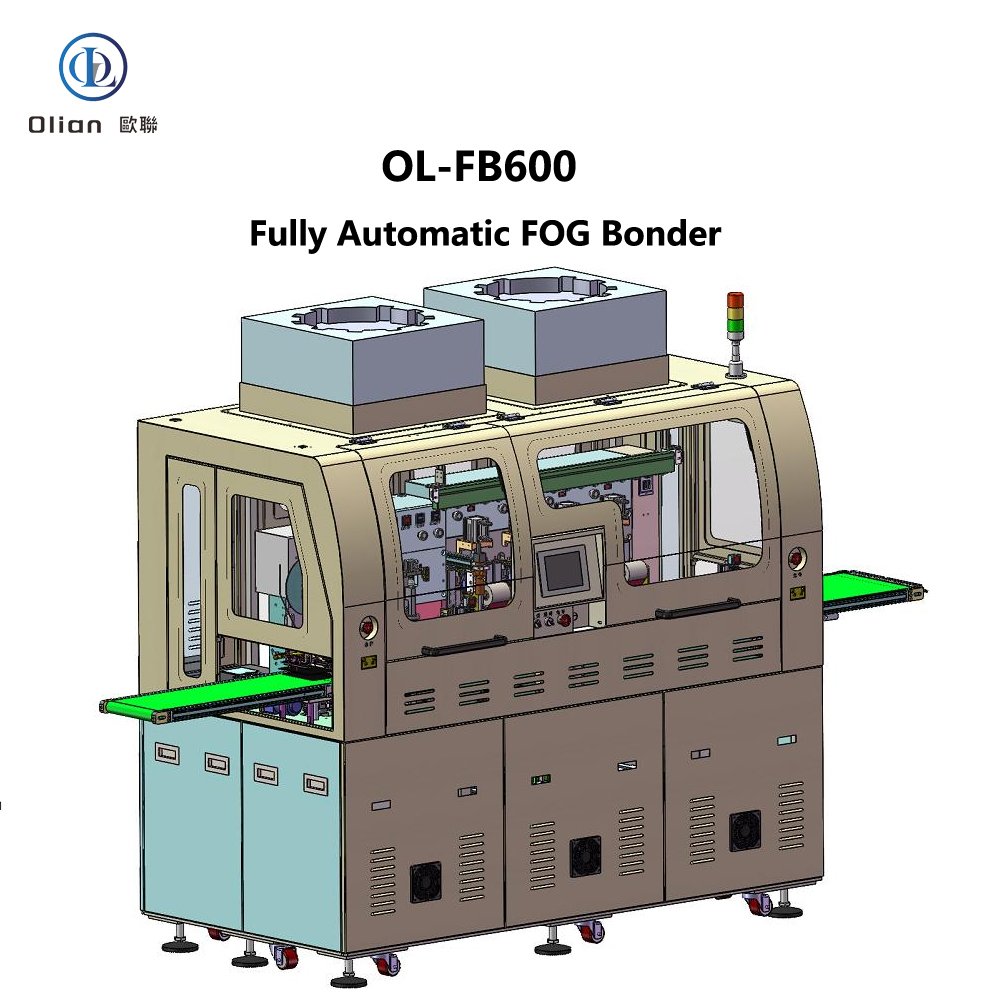
The FB-600 Fully Automatic FOG (Film on Glass) Bonder is a cutting-edge device designed for the manufacturing of LCD products. This machine is specifically tailored for 1″-6.5″ vertical screen LCD products, handling single-edge, single-segment ACF (Anisotropic Conductive Film) attachment, pre-bonding, and main bonding processes. It can be integrated with other production line equipment for seamless manufacturing operations.
2. Equipment Information
Equipment Name: Fully Automatic FOG Bonder
Model: FB-600
Application: Suitable for LCD products with sizes from 1″ to 6.5″, designed for automatic ACF application, pre-bonding, and main bonding of single-sided, single FPC (Flexible Printed Circuit).
Compatibility: Can be integrated with other machines in a production line for seamless operation.
3. Working Principle
The FB-600 operates through a series of coordinated mechanical and automated processes:
Feeding: Components are fed via conveyor belts or platforms, either manually or automatically from connected machines.
Positioning: A robotic arm (Mechanical Hand 1) picks up the LCD, which is then corrected in position using CCD (Charge-Coupled Device) technology before being placed on the ACF platform.
ACF Application: The ACF platform advances, the pressing head descends to apply the ACF, and then retreats for position verification and ACF attachment quality inspection.
Pre-bonding: Another robotic arm (Mechanical Hand 2) places the LCD on the pre-bonding platform while the FPC is simultaneously positioned. The pressing head then performs the pre-bonding.
Main Bonding: Mechanical Hand 3 transfers the product to four main bonding platforms for final bonding, after which Mechanical Hand 4 moves the finished product to the downstream platform or conveyor belt.
4. Product Specifications
LCD Specifications
Size Range: Minimum 20mm x 20mm, Maximum 150mm x 90mm, Thickness 0.15mm to 1.1mm.
Alignment Marks: Pitch ≥ 5mm between any two points on the glass, Mark size 200µm to 1000µm.
FPC Specifications
Size Range: Minimum 20mm x 10mm, Maximum 150mm x 80mm, Thickness 0.1mm to 0.5mm.
Terminal Pitch: ≥ 50µm.
Alignment Marks: Pitch 5mm to 70mm.
ACF Specifications
Types: Roll-based, 2-layer or 3-layer.
Application Length: 5mm to 80mm (adjustable based on bonding head length and customer requirements).
Application Width: 0.8mm to 2.5mm.
Reel Specifications: Inner diameter options of 18mm and 25mm, Maximum reel diameter 200mm.
Linear Motors: Yakobes/Linea/Dongxin (China/China/China).
Ball Screws: THK/Hiwin/TBI (Japan/China/China).
Guideways: THK/Hiwin/TBI (Japan/China/China).
Pneumatic Components: SMC/Airtac (Japan/China).
PLC: Keyence (Japan).
Touchscreen: Proface (Japan).
Sensors: Panasonic/Huan (Japan/China).
Power Supply: Mean Well (China).
Circuit Breakers and Contactors: Schneider/Shihlin/Chint (China).
Drag Chains: Igus (Germany).
In summary, the FB-600 Fully Automatic FOG Bonder represents a significant advancement in the field of LCD manufacturing equipment. Its precise engineering, user-friendly design, and comprehensive support make it an ideal choice for manufacturers seeking to enhance productivity and product quality in the competitive electronics market.
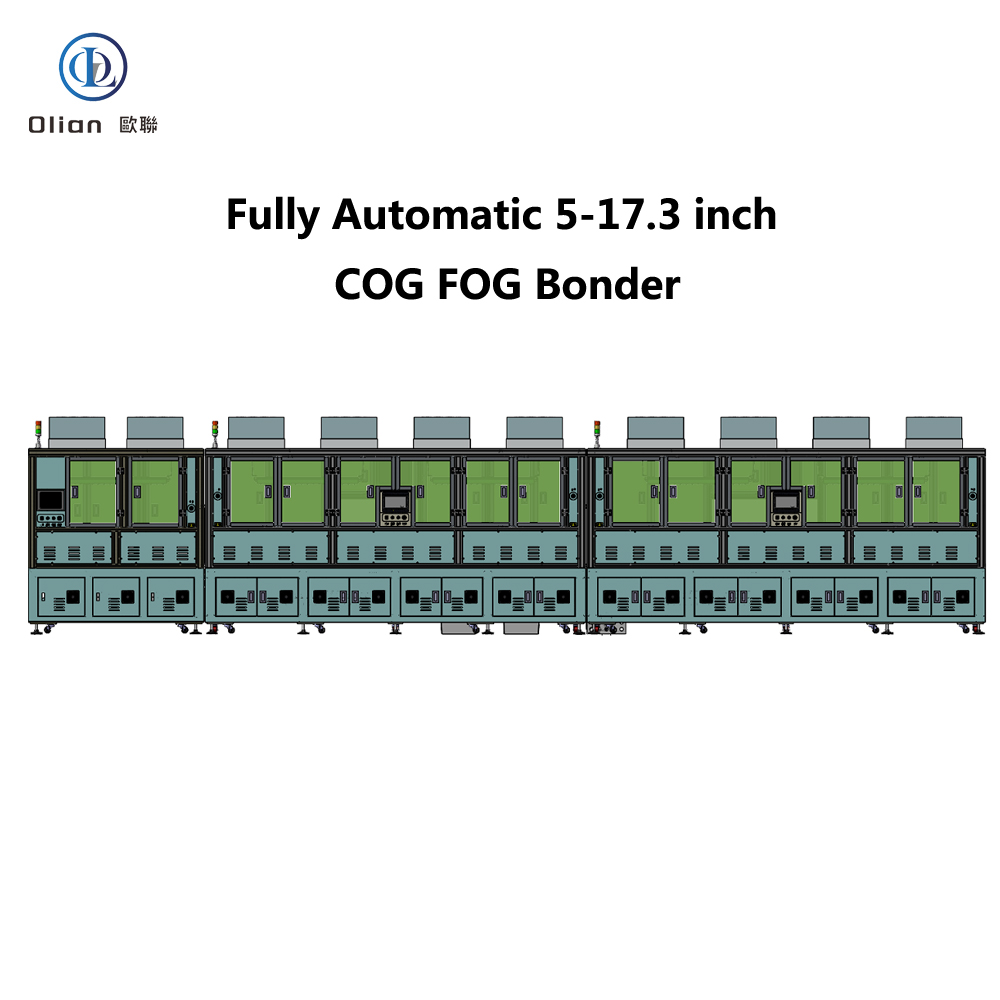
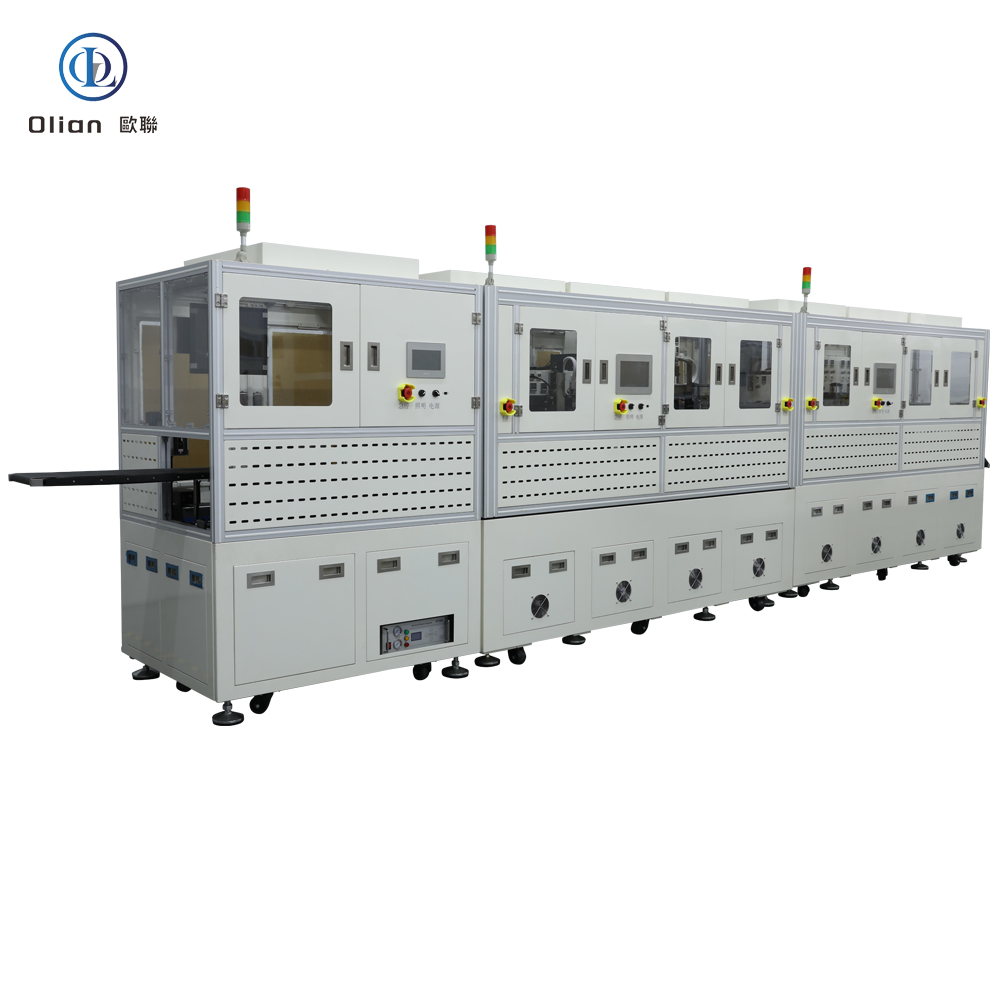
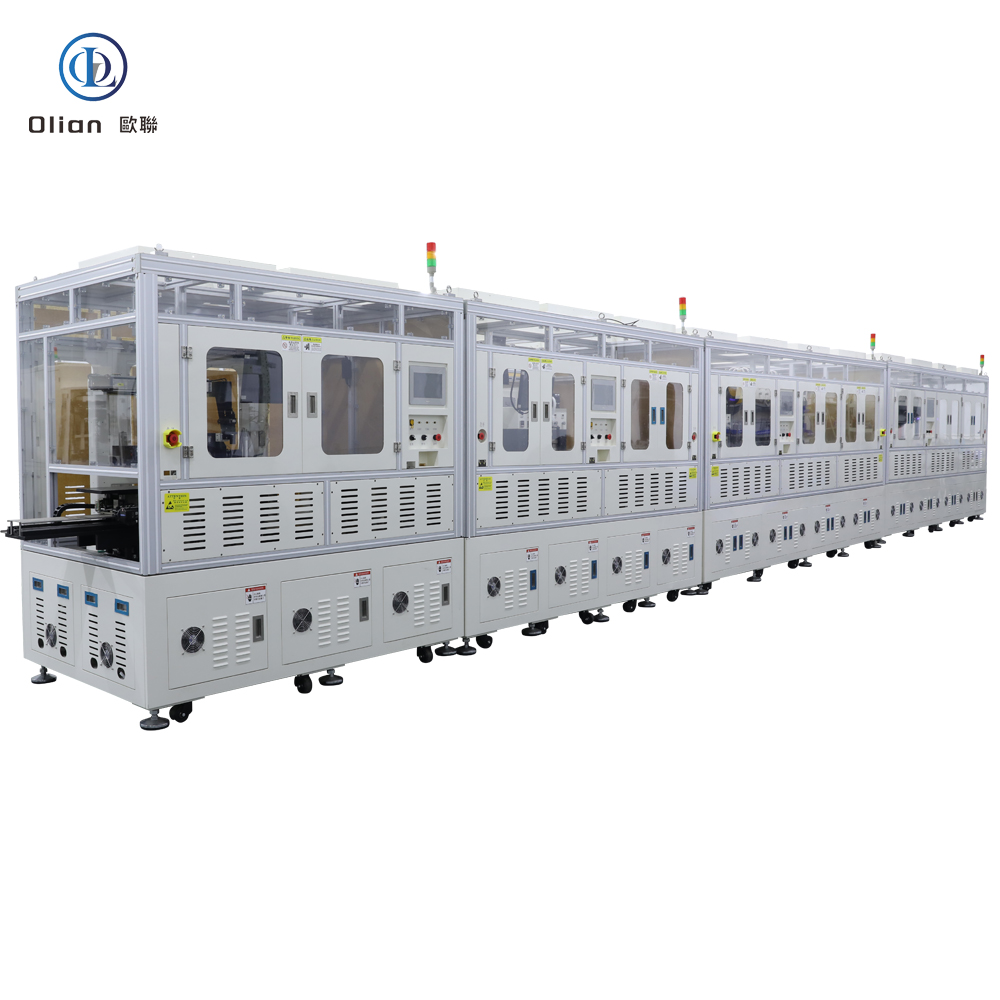
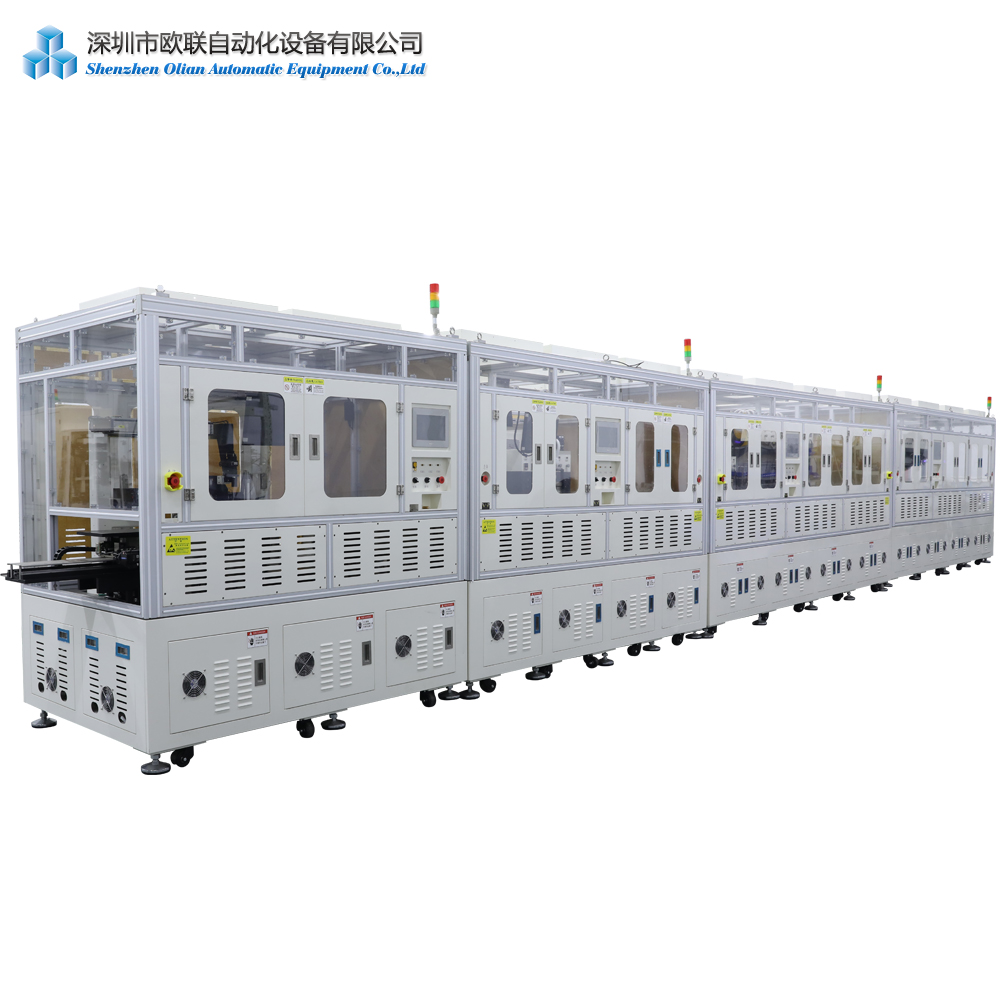
This document presents a comprehensive automation solution for the production of mid-size display modules (5-17.3 inches), focusing on the integration of various equipment for high-precision and high-efficiency manufacturing. The solution includes panel loading, terminal cleaning, COG (Chip on Glass) and FOG (FPC on Glass) bonding, as well as FPC (Flexible Printed Circuit) feeding. Each component is designed to work seamlessly with others to ensure smooth production flow and superior product quality.
Equipment Overview
1. Panel Loading Machine (LLD3000)
Panel Size Range: 5″ to 17.3″ (MIN: 80×80 mm, MAX: 380×380 mm)
Thickness: 0.15–0.7 mm
Tack Time: ≤4 seconds for 7″ panels (non-stop loading)
Vacuum & Air Supply: Compatible with customer-provided vacuum or standalone pump
Plasma Parameters: Power 120-200W, temperature 60-100°C
Features: Visual correction, ACF detection, and dual-sided cleaning capability
Power: 220V/50Hz, 3KW
Dimensions: 1800(L) × 1200(W) × 1900(H) mm
3. Fully Automatic COG Bonding Machine (CB3000)
Panel Size Range: 5″ to 17.3″
Tack Time:
≤6.5 seconds for single IC (dual-panel mode)
≤9 seconds for dual ICs (single-panel mode)
Precision:
ACF: X±0.15mm/Y±0.1mm (3σ)
Main Press: X/Y±5um (3σ)
IC Supply: Dual feeders for non-stop loading
Power: Three-phase, 380V, 12.5KW
Dimensions: ~4080(L) × 1600(W) × 1900(H) mm
4. Fully Automatic FOG Bonding Machine (FB3000)
Panel Size Range: 5″ to 17.3″
Tack Time:
≤6.5 seconds for single FPC (non-Y type)
≤10 seconds for dual FPCs
Precision:
ACF: X±0.15mm/Y±0.1mm (3σ)
Main Press: Single-segment FPC: X/Y±15um (3σ); U-shaped FPC: X/Y±20um (3σ)
FPC Supply: Single or dual channels for flexible loading
Power: Three-phase, 380V, 10KW
Dimensions: ~4000(L) × 1470(W) × 1900(H) mm
5. Fully Automatic FPC Loading Machine (FLD3000)
FPC Size Range: MIN: 15×10mm, MAX: 100×175mm
Tack Time: ≤4 seconds for same FPC, ≤6 seconds for dual FPCs
Precision: ±0.03mm
Power: Single-phase, 220V, 3.5KW
Dimensions: ~1100(L) × 1450(W) × 1900(H) mm
Process Flow
Panel Loading: Panels are loaded automatically with precise handling.
Terminal Cleaning: Terminals are cleaned using IPA and plasma to ensure contamination-free surfaces.
ACF Application: ACF material is applied precisely onto the glass or FPC.
IC/FPC Bonding: ICs or FPCs are aligned and bonded onto the glass using COG or FOG processes.
AOI Inspection: Products undergo automated optical inspection to ensure quality.
Key Features
High Precision: Ensures accurate alignment and bonding for superior product quality.
Automation: Reduces manual intervention, minimizing errors and improving efficiency.
Versatility: Compatible with various panel sizes and FPC configurations.
Reliability: Robust construction and high-quality components ensure consistent performance.
Conclusion
This automation solution for mid-size display modules offers a comprehensive approach to efficient and precise manufacturing. By integrating advanced technologies and equipment, it ensures high yield, superior quality, and cost-effectiveness, making it ideal for modern display production environments.
Display Screen Production lines,In the dynamic world of electronics manufacturing, Shenzhen Olian offers a comprehensive range of solutions designed to meet the high-precision requirements of modern display and electronic component production. From flexible screen glue field production to intelligent locomotive and notebook product lines, our solutions are tailored to enhance efficiency, reliability, and quality.
ACF Bonding Parts and AccessoriesMobile Phones Tablets and Industrial Control Products Whole Line Solution for TFT DisplaysSmart Wear LCD OLED Bonding Production Whole Line SolutionCOF COP COG IC PRE BONDERIC MIAN BONDERFOG FOP FOF FOB T-FOG FPC Flex Cable Bonding Machine
High-Level Flexible Screen Glue Field Production Solutions
Our high-level flexible screen glue field production solutions are designed for the precise application of adhesives in the production of flexible OLED displays. These solutions support a combination of COG/FOG, COF/FOF, and COP/FOP processes, ensuring high-quality connections and efficient production
Intelligent Locomotive and Notebook Product Line Solutions
For the manufacturing of intelligent locomotive and notebook products, Shenzhen Olian provides advanced production line solutions. These solutions are designed to handle the specific requirements of these products, ensuring high precision and reliability in every step of the manufacturing process
Display Product Line Solutions
Our display product line solutions cover a wide range of processes, including bonding, laminating, and dispensing. These solutions are suitable for various display technologies such as LCD, OLED, Mini LED, and Micro LED. They are designed to ensure high-quality connections and efficient production, making them ideal for manufacturers of smartphone screens, wearable devices, large TV panels, and advanced OLED displays
Commercial Display Screen Flexible Bonding Production Line Solutions
For commercial display screens, Shenzhen Olian offers flexible bonding production line solutions. These solutions are designed to handle the specific requirements of large-format displays, ensuring high precision and reliability. They are suitable for a variety of applications, including advertising displays, public information displays, and industrial control systems
Electronic Paper Line Solutions
Our electronic paper line solutions include laminating, bonding, and dispensing field line solutions. These solutions are designed to meet the high-precision requirements of E-paper displays, ensuring high-quality connections and efficient production. They are suitable for a variety of applications, including e-readers, smart labels, and public information displays
Backlight Leading, Laminated Film, Shading, and Wrapping Line Equipment Solutions
Shenzhen Olian provides comprehensive solutions for backlight leading, laminated film, shading, and wrapping line equipment. These solutions are designed to ensure high precision and reliability in the production of displays, making them ideal for manufacturers of smartphone screens, large TV panels, and other advanced displays
Fingerprint Module Under the Screen Bond Spot Glue and AOI Intelligent Detection Field Solutions
Our fingerprint module under the screen bond spot glue and AOI intelligent detection field solutions are designed to ensure high precision and reliability in the production of fingerprint modules. These solutions support high-precision bonding and intelligent detection, making them ideal for manufacturers of smartphone screens and other advanced displays
Automatic OCA and OCR Fit Field Production Solutions
For the production of optical clear adhesive (OCA) and optical clear resin (OCR) fits, Shenzhen Olian offers automatic production solutions. These solutions are designed to ensure high precision and reliability, making them ideal for manufacturers of smartphone screens, wearable devices, and other advanced displays
FPC Covering Film, EMI Automatic Laminating, and FPC Exposure Special Equipment Field Solutions
Our FPC covering film, EMI automatic laminating, and FPC exposure special equipment field solutions are designed to meet the high-precision requirements of flexible printed circuit (FPC) production. These solutions ensure high-quality connections and efficient production, making them ideal for manufacturers of smartphone screens, wearable devices, and other advanced displays
3C Product Inspection and Packaging Production Line Solutions
Finally, Shenzhen Olian provides comprehensive solutions for 3C product inspection and packaging production lines. These solutions are designed to ensure high precision and reliability in the inspection and packaging of 3C products, making them ideal for manufacturers of smartphones, tablets, and other electronic devices
Why Choose Shenzhen Olian Display Screen Production lines,?
By choosing Shenzhen Olian, you benefit from:
Advanced Technology: State-of-the-art solutions designed for precision and reliability.
Comprehensive Support: A wide range of processes and technologies to meet diverse manufacturing requirements.
Proven Track Record: Long-term partnerships with leading companies in the industry, ensuring high-quality and reliable solutions.
Customization: Tailored solutions to fit specific manufacturing processes and requirements, providing a customized and efficient production line.
In conclusion, Shenzhen Olian’s Display Screen Production lines, comprehensive solutions for high-level flexible screen glue field production and beyond offer a reliable and efficient approach to modern display and electronic component manufacturing. Whether you are producing smartphone screens, wearable devices, large TV panels, or advanced OLED displays, Shenzhen Olian’s solutions can help you achieve high-quality, efficient, and reliable production processes.
In the rapidly evolving world of electronics and display manufacturing, precision bonding technologies play a crucial role in creating high-quality, reliable, and innovative products. Whether you are producing smartphone screens, wearable devices, large TV panels, or advanced OLED displays, our company offers a comprehensive range of bonding machines and solutions to meet your specific needs. Below is an introduction to our product offerings, covering various bonding technologies and applications.
Chip on Glass (COG) Bonding Machines
COG (Chip on Glass) technology is a widely used method for mounting LCD driver chips directly onto the glass substrate of a display panel
. This technique is known for its simplicity, cost-effectiveness, and reliability. Our COG bonding machines are designed to provide high precision and efficiency, making them ideal for applications such as smartphone screens, LCD panels, and other display devices
. We offer both pre-bonding and main-bonding machines, ensuring accurate alignment and strong connections.
Chip on Film (COF) Bonding Machines
COF (Chip on Film) technology represents a significant advancement in display manufacturing. It involves mounting integrated circuits (ICs) onto flexible printed circuits (FPCs), which can then be bent and folded to fit compact spaces
. Our COF bonding machines support high-speed production and offer precise temperature and pressure control, ensuring reliable connections for applications such as flexible screens, smartwatches, and other wearable devices
. We provide both COF pre-bonding and main-bonding machines, tailored to meet the demands of modern display manufacturing
.
Chip on Plastic (COP) Bonding Machines
COP (Chip on Plastic) technology is another innovative approach, where ICs are mounted directly onto plastic substrates. This method is particularly useful for creating lightweight and flexible displays
. Our COP bonding machines are designed to handle the unique challenges of plastic substrates, offering high precision and reliability. These machines are ideal for applications such as flexible OLED displays and wearable devices
.
FPC on Glass (FOG) Bonding Machines
FOG (FPC on Glass) bonding involves attaching flexible printed circuits to glass substrates. This technique is commonly used in applications requiring flexibility and compact design, such as touch screens and wearable devices
. Our FOG bonding machines feature advanced alignment systems and precise temperature control, ensuring high-quality connections. We offer both hot press and automated bonding solutions for FOG applications
.
FPC on PCB (FOB) Bonding Machines
FOB (FPC on PCB) bonding machines are designed for attaching flexible printed circuits to printed circuit boards. These machines are essential for creating compact and reliable electronic assemblies, commonly used in smartphones, tablets, and other consumer electronics
. Our FOB bonding machines provide high precision and flexibility, supporting both manual and automated production processes
.
FPC on FPC (FOF) Bonding Machines
FOF (FPC on FPC) bonding involves connecting flexible printed circuits to each other. This technique is ideal for applications requiring extreme flexibility and compactness, such as wearable devices and flexible displays
. Our FOF bonding machines offer high precision and reliability, ensuring strong and durable connections.
Anisotropic Conductive Film (ACF) Bonding Machines
ACF (Anisotropic Conductive Film) bonding is a versatile technique used in various bonding processes, including COG, COF, and FOG
. Our ACF bonding machines are designed to provide precise temperature, pressure, and alignment control, ensuring reliable and high-quality connections. We offer a range of ACF bonding solutions, including pre-bonding and main-bonding machines
.
Tape Automated Bonding (TAB) Machines
TAB (Tape Automated Bonding) is a technique used for bonding integrated circuits to substrates using tape carriers. Our TAB bonding machines are designed for high-speed production and offer precise alignment and bonding capabilities
. These machines are ideal for applications requiring high-density interconnections and compact designs
.
Flexible Printed Circuit (FPC) Bonding Machines
FPC (Flexible Printed Circuit) bonding machines are essential for creating flexible and lightweight electronic assemblies. Our FPC bonding machines offer high precision and reliability, supporting various bonding processes and applications
. These machines are ideal for applications such as wearable devices, flexible displays, and other consumer electronics
.
Additional Bonding Solutions
In addition to the above technologies, we also offer specialized bonding machines for various applications, including:
Touch Panel FPC Bonding Machines: For bonding flexible circuits to touch panels.
Zebra Paper Bonding Machines: For bonding components to Zebra paper.
Pulse Hot Press Machines: For applications requiring rapid heating and cooling.
OLED Bonding Machines: For bonding OLED displays.
Camera FPC Bonding Machines: For bonding flexible circuits to camera modules.
Why Choose Our Bonding Machines?
Our bonding machines are designed with the latest innovations in mind, ensuring high precision, reliability, and efficiency. Key features of our machines include:
High Precision: Equipped with advanced vision systems and precise temperature control.
Versatility: Support a wide range of bonding processes and applications.
Automation: Available in both semi-automatic and fully automatic configurations.
Customization: Tailored solutions to fit your specific manufacturing processes and requirements.
Conclusion
Whether you are producing smartphone screens, wearable devices, large TV panels, or advanced OLED displays, our comprehensive range of bonding machines is designed to meet your specific needs. With advanced features such as high precision, versatility, and automation, our machines are ideal for ensuring high-quality connections and efficient production processes. Contact us today to find the perfect bonding machine for your application.
Advanced Bonding Machines for Display and Electronics Manufacturing
In the dynamic world of electronics and display manufacturing, precision and reliability are paramount. Whether you are producing smartphone screens, wearable devices, large TV panels, or advanced OLED displays, the right bonding machine is essential for ensuring high-quality connections and efficient production processes. Our company offers a wide range of state-of-the-art bonding machines designed to meet the diverse needs of modern manufacturing. Below is an overview of our product offerings, tailored to help you find the perfect solution for your specific requirements.
Bonding Machines for Mobile and Wearable Devices
Mobile Phone Bonding Machines
Our mobile phone bonding machines are designed to handle the precise assembly requirements of smartphones. These machines support various bonding processes, including COG (Chip on Glass), COF (Chip on Film), and FPC (Flexible Printed Circuit) bonding. They are equipped with high-definition microscopes, digital pressure gauges, and vacuum generators to ensure accurate alignment and reliable bonding
Smart Watch LCD Bonding Machines
For the growing wearable technology market, our smart watch LCD bonding machines offer high precision and flexibility. These machines are ideal for bonding small LCD panels and flexible circuits, ensuring that your wearable devices are both durable and reliable
Wearable Equipment Bonding Machines
Our wearable equipment bonding machines are versatile and can handle a variety of components used in smartwatches, fitness trackers, and other wearable devices. These machines support multiple bonding processes, including COG, COF, and FOG (Film on Glass) bonding
Bonding Machines for Display Panels
TV Panel Bonding Machines
Our TV panel bonding machines are designed for large-scale production of LCD and LED TV panels. These machines support high-speed bonding processes and are equipped with advanced features such as pulse heating and constant temperature control to ensure consistent bonding quality
LCM and LCD Module Bonding Machines
For the production of Liquid Crystal Modules (LCMs) and LCD modules, our bonding machines offer high precision and reliability. These machines support various bonding processes, including COG, FOG, and OLB (Outer Lead Bonding), and are suitable for both small and large-scale production
Flat Panel Display Bonding Machines
Our flat panel display bonding machines are designed to handle a wide range of display sizes and types, from small wearable devices to large TV panels. These machines are equipped with advanced vision systems and precise temperature control to ensure high-quality bonding
Specialized Bonding Machines
COG, COP, and COF Bonding Machines
Our COG (Chip on Glass), COP (Chip on Plastic), and COF (Chip on Film) bonding machines are designed for high-precision bonding of integrated circuits (ICs) and flexible printed circuits (FPCs) to various substrates. These machines offer both semi-automatic and fully automatic configurations, making them suitable for a wide range of production volumes
FOG, FOB, and FOF Bonding Machines
Our FOG (Film on Glass), FOB (Film on Board), and FOF (Film on Film) bonding machines are designed for bonding flexible circuits to various substrates. These machines support both pulse heating and constant temperature bonding processes, ensuring reliable connections in your display assemblies
TAB, OLB, and IC Bonding Machines
Our TAB (Tape Automated Bonding), OLB (Outer Lead Bonding), and IC bonding machines are versatile tools for bonding integrated circuits and other components. These machines offer high precision and reliability, making them ideal for a wide range of electronic manufacturing applications
FPC, Glass, and Touch Panel Bonding Machines
Our FPC (Flexible Printed Circuit), glass, and touch panel bonding machines are designed to handle the specific requirements of flexible circuits and touch-sensitive displays. These machines support various bonding processes, including COG, FOG, and COF bonding, and are equipped with advanced features such as high-definition microscopes and precise temperature control
OLED, Mini LED, and Micro LED Bonding Machines
For advanced display technologies such as OLED, Mini LED, and Micro LED, our bonding machines offer high precision and reliability. These machines are designed to handle the specific requirements of these advanced displays, ensuring high-quality connections and efficient production
Zebra Paper and Flex Cable Bonding Machines
Our Zebra paper and flex cable bonding machines are designed for bonding components to Zebra paper and flexible cables. These machines offer high precision and reliability, making them ideal for applications where flexibility and compactness are crucial
Why Choose Our Bonding Machines?
Our bonding machines are designed with the latest innovations in mind, ensuring high precision, reliability, and efficiency. Key features of our machines include:
High Precision: Equipped with advanced vision systems and precise temperature control, our machines ensure reliable connections.
Versatility: Our machines support a wide range of bonding processes and can handle various substrates and components.
Automation: Available in both semi-automatic and fully automatic configurations, our machines can meet the needs of small-scale production and large-scale manufacturing.
Customization: We offer tailored solutions to fit your specific manufacturing processes and requirements.
Conclusion
Whether you are producing smartphone screens, wearable devices, large TV panels, or advanced OLED displays, our comprehensive range of bonding machines is designed to meet your specific needs. With advanced features such as high precision, versatility, and automation, our machines are ideal for ensuring high-quality connections and efficient production processes. Contact us today to find the perfect bonding machine for your application.
In the modern electronics manufacturing landscape, Anisotropic Conductive Film (ACF) bonding machines have become indispensable tools for creating reliable and high-quality connections between various components. Whether you are involved in the production of LCD panels, flexible circuits, or advanced display technologies, the right ACF bonding machine can significantly enhance your manufacturing efficiency and product quality. This article provides an in-depth introduction to the different types of ACF bonding machines and their applications, helping you find the perfect solution for your needs.
ACF Bonding Parts and AccessoriesSmart Wear LCD OLED Bonding Production Whole Line SolutionFOG FOP FOF FOB T-FOG FPC Flex Cable Bonding MachineFOG FOP FOF FOB T-FOG FPC Flex Cable Bonding MachineFOG FOP FOF FOB T-FOG FPC Flex Cable Bonding MachineFPC PRE BONDING MAIN BONDERIC MIAN BONDERCOF PRE BONDER MAIN BONDERCOF COP COG IC PRE BONDERCOF COP COG IC BONDERFOG FOP FOF FOB T-FOG FPC Flex Cable Bonding MachineFOG FOP FOF FOB T-FOG FPC Flex Cable Bonding Machine7-17INCH FOG FOB PRE AND MAIN BONDING MACHINE
Introduction to ACF Bonding Machines
ACF bonding machines are specialized devices designed to bond two substrates using Anisotropic Conductive Film (ACF). These machines apply heat, pressure, and precise alignment to ensure a strong and reliable electrical and mechanical connection between components such as LCD panels, PCBs, FPCs, and IC chips
. ACF bonding is widely used in applications like COG (Chip on Glass), COF (Chip on Film), FOG (Film on Glass), FOB (Film on Board), and more
.
Types of ACF Bonding Machines
1. ACF Pre-Bonding Machines
ACF pre-bonding machines are used for the initial alignment and attachment of ACF tape to the substrates. These machines often feature semi-automatic operation, allowing operators to place the components manually while the machine handles precise alignment and pre-bonding
. Pre-bonding ensures that the components are accurately positioned before the final bonding process.
2. ACF Main-Bonding Machines
Main-bonding machines are responsible for the final bonding process, where the components are pressed together under precise temperature and pressure conditions. These machines are available in both constant heat and pulse heat systems, offering flexibility based on the specific requirements of the bonding process
. Main-bonding machines can be fully automated, providing high throughput and consistent bonding quality.
3. ACF Heat Press Machines
ACF heat press machines, also known as hot press machines, are versatile tools used for bonding components using ACF. These machines can operate in both constant temperature and pulse heating modes, making them suitable for a wide range of applications
. They are equipped with features like multi-stage temperature control, real-time temperature curve display, and CCD vision systems for precise alignment
.
4. Pulse Heating Bonding Machines
Pulse heating bonding machines use a transformer to generate low voltage and high current, which quickly heats the bonding area. This method allows for rapid heating and cooling, ensuring precise temperature control and efficient bonding
. Pulse heating machines are ideal for applications where quick and precise bonding is required, such as in COF and FOG bonding processes
.
5. Constant Temperature Bonding Machines
Constant temperature bonding machines maintain a steady temperature throughout the bonding process. These machines are widely used in LCD panel assembly and other applications where consistent temperature control is crucial
. They offer features like digital pressure gauges, vacuum generators, and high-definition microscopes for precise bonding
.
Applications of ACF Bonding Machines
ACF bonding machines are used in various industries, including:
LCD and LED Panel Manufacturing: For bonding ICs, FPCs, and other components to glass substrates.
Flexible Circuit Assembly: For creating connections between flexible printed circuits and other components.
Touch Screen Production: For bonding touch sensors to display panels.
Mobile Phone and Tablet Manufacturing: For assembling components in mobile devices.
Why Choose Our ACF Bonding Machines?
Our company offers a comprehensive range of ACF bonding machines designed to meet the diverse needs of the electronics manufacturing industry. Our machines are known for their:
High Precision: Equipped with advanced vision systems and precise temperature control.
Versatility: Available in both semi-automatic and fully automatic configurations.
Reliability: Built with high-quality components and rigorous testing.
Customization: Tailored solutions to fit specific manufacturing processes.
Conclusion
ACF bonding machines are essential tools in modern electronics manufacturing, providing reliable and high-quality connections between various components. Whether you need a pre-bonding machine for initial alignment or a main-bonding machine for the final assembly, our company offers a wide range of solutions to meet your needs. With advanced features like pulse heating, constant temperature control, and precise alignment, our ACF bonding machines are designed to enhance your manufacturing efficiency and product quality. Contact us today to find the perfect ACF bonding machine for your application.
In the rapidly evolving world of display technology, bonding machines play a crucial role in the assembly and manufacturing of various electronic components and displays. Our company is proud to offer a wide range of advanced bonding solutions tailored to meet the diverse needs of the industry. Whether you are looking to bond integrated circuits, flexible printed circuits, or other components, we have the right machine for you.
Mid Size 7-17 Inch Vehicle Display and Notebook Whole Line SolutionACF Bonding Parts and AccessoriesMobile Phones Tablets and Industrial Control Products Whole Line Solution for TFT DisplaysFOG FOP FOF FOB T-FOG FPC Flex Cable Bonding MachineFOG FOP FOF FOB T-FOG FPC Flex Cable Bonding MachineFOG FOP FOF FOB T-FOG FPC Flex Cable Bonding MachineIC MIAN BONDERCOF COP COG IC PRE BONDERCOF IC BONDER7-17 Inch Semi Automatic Bonding Machines Production Line SolutionFOG FOP FOF FOB T-FOG FPC Flex Cable Bonding MachineFOG FOP FOF FOB T-FOG FPC Flex Cable Bonding Machine
ACF Bonder (Anisotropic Conductive Film Bonder)
ACF bonders are essential for bonding two substrates, such as LCDs, PCBs, and FPCs, using Anisotropic Conductive Film (ACF). These machines are available in both constant heat and pulse heat systems, with vision alignment capabilities for precise bonding
. They are widely used in applications like COB (Chip on Board), COF (Chip on Film), COG (Chip on Glass), COP (Chip on Panel), FOB (Film on Board), and FOG (Film on Glass).
COG Bonder (Chip on Glass Bonder)
COG bonders are specifically designed for attaching integrated circuits (ICs) directly onto glass substrates. These machines ensure high precision and reliability, making them ideal for the production of LCD panels used in consumer electronics, automotive displays, and industrial applications
. Our COG bonders come in both pre-bonding and main-bonding configurations, with options for manual or automated loading.
COP Bonder (Chip on Panel Bonder)
Similar to COG bonders, COP bonders are used for bonding ICs directly onto display panels. They are particularly useful for flexible AMOLED production, offering advanced functions to ensure high bonding quality and productivity
.
COF Bonder (Chip on Film Bonder)
COF bonders are designed for bonding ICs onto flexible films. These machines are versatile and can be used for various applications, including COF on glass, COF on board, and COF on film bonding
. They are available in both manual and automatic configurations, with options for single or dual heads.
FOG Bonder (Film on Glass Bonder)
FOG bonders are used for bonding flexible printed circuits (FPCs) onto glass substrates. These machines come in both pulse heat and constant heat versions, with top-bottom alignment systems for precise bonding
. They are suitable for a wide range of applications, including LCD and OLED panel manufacturing.
FOB Bonder (Film on Board Bonder)
FOB bonders are designed for bonding FPCs onto PCBs. They offer similar features to FOG bonders, including precise alignment and reliable bonding capabilities
. These machines are essential for applications where flexibility and compactness are required.
FOF Bonder (Film on Film Bonder)
FOF bonders are used for bonding FPCs onto other FPCs. These machines are particularly useful in applications where space is limited and flexibility is crucial
. They offer high precision and reliability, ensuring a strong and stable connection between the components.
TAB Bonder (Tape Automated Bonding Machine)
TAB bonders are used for bonding integrated circuits onto substrates using tape automated bonding techniques. These machines are known for their high precision and reliability, making them ideal for a wide range of electronic manufacturing applications
.
OLB Bonder (Outer Lead Bonding Machine)
OLB bonders are used for bonding the outer leads of integrated circuits onto substrates. These machines are essential for ensuring a reliable connection between the IC and the display panel
. They offer high precision and reliability, making them a crucial part of the display manufacturing process.
IC Bonder (Integrated Circuit Bonder)
IC bonders are versatile machines used for bonding integrated circuits onto various substrates. They are available in both manual and automated configurations, with options for single or dual heads
. These machines are essential for a wide range of electronic manufacturing applications.
FPC Bonder (Flexible Printed Circuit Bonder)
FPC bonders are designed for bonding flexible printed circuits onto various substrates. These machines offer high precision and reliability, making them ideal for applications where flexibility and compactness are required
. They are available in both manual and automated configurations, with options for single or dual heads.
Glass Bonder
Glass bonders are used for bonding components directly onto glass substrates. These machines are essential for the production of LCD and OLED panels, offering high precision and reliability
. They are available in both manual and automated configurations, with options for single or dual heads.
LCD Panel Bonder
LCD panel bonders are specifically designed for the assembly of LCD panels. These machines offer high precision and reliability, ensuring a strong and stable connection between the components
. They are available in both manual and automated configurations, with options for single or dual heads.
LED Panel Bonder
LED panel bonders are used for bonding components onto LED panels. These machines offer high precision and reliability, making them ideal for applications where brightness and efficiency are crucial
. They are available in both manual and automated configurations, with options for single or dual heads.
Mini LED Bonder
Mini LED bonders are designed for the assembly of Mini LED panels. These machines offer high precision and reliability, ensuring a strong and stable connection between the components
. They are available in both manual and automated configurations, with options for single or dual heads.
Micro LED Bonder
Micro LED bonders are used for the assembly of Micro LED panels. These machines offer extremely high precision and reliability, making them ideal for applications where brightness, efficiency, and resolution are crucial
. They are available in both manual and automated configurations, with options for single or dual heads.
Zebra Paper Bonder
Zebra paper bonders are used for bonding components onto Zebra paper. These machines offer high precision and reliability, making them ideal for applications where flexibility and compactness are required
. They are available in both manual and automated configurations, with options for single or dual heads.
Touch Panel FPC Bonder
Touch panel FPC bonders are specifically designed for bonding flexible printed circuits onto touch panels. These machines offer high precision and reliability, ensuring a strong and stable connection between the components
. They are available in both manual and automated configurations, with options for single or dual heads.
Conclusion
Our company offers a comprehensive range of bonding machines designed to meet the diverse needs of the display manufacturing industry. From ACF bonders to Micro LED bonders, we have the right machine for every application. Our machines are known for their high precision, reliability, and versatility, making them ideal for a wide range of electronic manufacturing applications. We are committed to providing our customers with the best possible solutions and support to ensure their success in the competitive world of display technology.