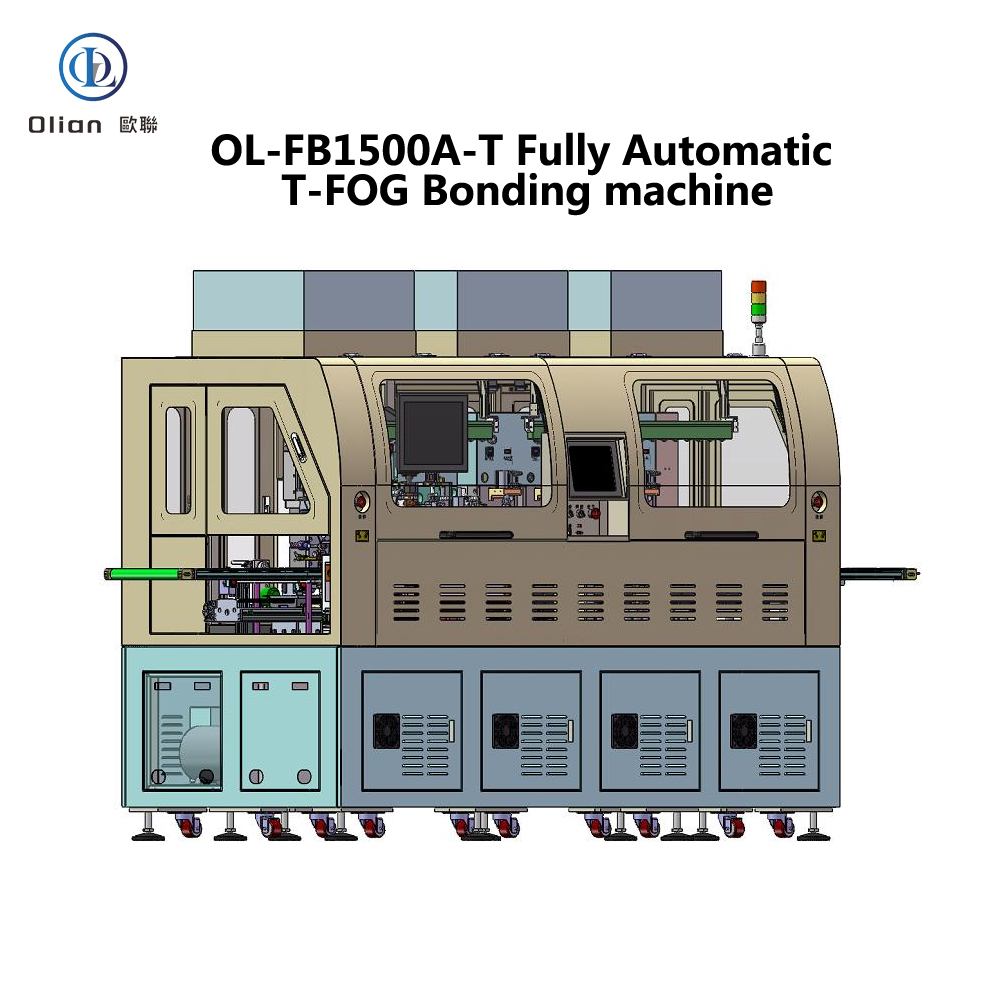
FOG = Flex On Glass FOB = Flex On Board (rigid PCB) FOF = Flex On Flex (two flexible circuits) TFOG = Tape (or Tab) Flex On Glass TFOF = Tape Flex On Flex
In short, a “fully automatic FOG/FOB/FOF/TFOG/TFOF bonder” is one unified platform that can assemble any combination of flexible printed circuits (FPC), rigid PCBs, glass substrates, polyimide tapes, copper flex heaters, even ultra-thin stainless-steel stiffeners—by using Anisotropic Conductive Film (ACF) and a servo-controlled pulse-heat or constant-heat bonding head.
One machine, five processes, zero manual intervention after loader.
2. Why “fully automatic” changes everything
Legacy semi-automatic cells need an operator every 8–12 seconds to place covers, align gold-fingers, close the vacuum tray and press “start”.
A fully automatic bonder integrates:
• 3-axis or 4-axis linear-motor stages with 0.5 µm encoder feedback
• Dual-gantry pick-and-place for 2-second substrate swap
• Up-looking and down-looking 5-MP vision pairs + coaxial lighting for fiducial, pin-mark and edge alignment
• ACF cut-feed-tack module that indexes the tape in 10 µm steps。removes 5 µm of backing liner and pre-tacks in one motion
• Pulse-heat power supply (typ. 2 kW, 400 kHz) that can ramp the thermode from 25 °C to 400 °C in 180 ms and cool to 80 °C in 120 ms
• Force-controlled Z-axis (0.01 MPa resolution) with real-time piezo sensor to prevent “over-squeeze” of 25 µm pitch ACF
• In-line four-wire Kelvin tester that measures contact resistance (mΩ) and isolation (GΩ) before the panel is released
• SMEMA-compatible conveyor so the machine drops straight into an SMT line
Result: UPH jumps from 250 pcs/h (manual) to 750–900 pcs/h (fully automatic) while holding ±1 µm alignment and ±0.5 °C temperature repeatability—numbers that are impossible for human hands.
3. Core working principle, step by step
Step 1 – Loader: robot arm picks the incoming tray (glass, PCB or flex) and places it on the pre-heating stage (60–80 °C).
Step 2 – ACF application: the feeder advances the anisotropic conductive film by the exact length of the bond area (±0.1 mm); a ceramic cutter slices at 45° to avoid stringers; vision confirms no air bubbles; a silicone roller tacks the ACF at 0.2 MPa and 90 °C.
Step 3 – Pre-alignment: the lower camera maps the substrate fiducials; the upper camera maps the flex tail gold-fingers; software calculates X, Y, θ offset and warpage compensation.
Step 4 – Final placement: the gantry places the flex or second substrate onto the ACF with 50 µm gap remaining.
Step 5 – Bonding: the pulse-heat thermode descends at 5 mm/s; when force reaches set-point (e.g. 1.0 MPa) the power supply delivers a programmed profile—typically 1.5 s at 190 °C for 25 µm ACF, followed by a −3 °C/ms ramp to 80 °C under maintained pressure to freeze the conductive particles.
Step 6 – Quick cool & release: embedded TEC cold-plate drops the bond line to 50 °C in 2 s; the head lifts; the stage shuttles to the unloader.
Step 7 – Electrical test: Kelvin probes contact test pads; if resistance > 100 mΩ or isolation < 1 GΩ, the panel is routed to the rework conveyor; good parts stack in JEDEC trays or go directly to the next SMT machine.
4. Critical hardware modules explained
Pulse-heat power supply: uses high-frequency IGBT switching to deliver 1 kA within 2 ms; closed-loop PID watches both thermocouple and IR sensor to prevent overshoot. Thermode materials: molybdenum or titanium alloy, plasma-coated with anti-flux to stop ACF bleed; interchangeable cartridges allow 50 µm to 5 mm bond widths. Vision algorithm: sub-pixel edge detection + golden-template comparison; handles low-contrast glass edges, laser-cut flex outlines, even mirror-finished ITO. Force decoupling: flexure-based Z-stage isolates lateral forces, so when the thermode touches a 0.3 mm glass edge the system still reports true vertical load. Clean-room package: ISO Class 5 mini-environment with ionizer bars and ESD-safe coating; reduces particle defects from 300 ppm to <30 ppm on Gen-6 glass.
5. Software & data traceability
Every bond creates a digital twin: temperature graph, force curve, ACF lot number, operator ID, humidity, particle count. CSV files feed automatically into MES (Manufacturing Execution System) for full 21 CFR Part 11 traceability. When a smartphone OEM sees a field failure, engineers can trace back to the exact bond head, thermode serial number and ACF roll within minutes—something impossible in manual lines.
6. Applications you touch every day
• Smartphone OLED driver flex (FOG) – 25 µm pitch, 1 200 pins, 3-sided bonding • Automotive curved cluster (TFOG) – 12.3-inch glass, −40 °C to 95 °C thermal shock spec • Tablet touch sensor (FOF) – 10 µm ACF, ITO-to-metal-mesh, 120 Hz report rate • Industrial wearables (FOB) – 4-layer rigid-flex, 0.4 mm total thickness, IP68 waterproof • Medical disposable catheter (FOF) – 8 µm polyimide, biocompatible ACF, lot tracking for FDA
7. Choosing the correct model: key specifications
Panel size: modern platforms cover 1-inch smart-watchring up to 100-inch TV mother-glass; check max bond length (single-side vs shuttle). Pin pitch: entry-level heads handle 80 µm; high-end models with 5 µm alignment stage achieve 20 µm pitch on COF (Chip On Flex). Temperature range: standard 25–400 °C; for Cu-to-Cu micro-bumps order the 500 °C option. Force range: 5–500 N programmable; for stainless-steel flex heaters you may need 1 000 N high-force head. Cycle time: specify “dry cycle” vs “production cycle” (with vision + test); some vendors quote 3 s dry but real throughput is 8 s. UPH claim: ask for guaranteed number with ≤100 ppm defect rate, not best-case lab data.
8. Maintenance & uptime tips
Daily: wipe thermode with lint-free cloth + ethanol; inspect ACF cutter under microscope; run 5-point force calibration. Weekly: replace silicone cushion (compression set >0.1 mm); check camera calibration plate; back-up parameter database. Monthly: grease linear rails with PFPE vacuum grease; run full temperature uniformity map (≤3 °C across 300 mm). Yearly: send pulse-heat power supply for calibration; rebuild vacuum generator; update cyber-security patch on IPC.
9. Future roadmap – where the industry is heading
• 10 µm pitch roadmap: vendors are testing 40 000-pixel COF for 8K micro-LED; next-generation bonders will use 200 nm resolution encoders and active warpage compensation with piezo actuators. • Hybrid thermodes: combine laser pre-heat + contact thermode to bond silver-nano-ink on temperature-sensitive PET. • AI process window: machine-learning model watches 50 sensor streams in real time, predicts void risk 200 ms before it happens and auto-corrects force or temperature. • Sustainability: lead-free, halogen-free ACF pastes; low-temp curing (120 °C) to cut energy 35 %; recyclable carrier film. • Modular micro-factories: tabletop “bonder cells” (600 mm wide) that plug together like LEGO for rapid reconfiguration between FOG, FOB and FOF in the same shift.
10. Take-away
A fully automatic FOG FOB FOF TFOG TFOF bonder is no longer a niche machine hidden in display giants—it is the productivity engine that lets start-ups build wearables in Shenzhen, suppliers launch curved OLED clusters, and medical companies print disposable ECG patches.
By unifying ACF application, micron alignment, pulse-heat bonding and in-line electrical test inside one closed-loop platform, the latest generation delivers three things every production manager dreams of: higher throughput (750+ UPH), lower defect rate (<50 ppm) and complete digital traceability.
If your roadmap includes narrower pitches, thinner glass or flexible hybrid electronics, investing early in a fully automatic FOG/FOB/FOF/TFOG/TFOF bonder is the safest way to guarantee yield, scalability and speed-to-market for the next decade.